The idea of AI translation services sounds like a wet dream for global businesses. Instant translations, lower costs, endless scalability. What’s not to love?
But here’s the real question: are AI translation services actually helping businesses scale, or are they just making it easier to cut corners?
Many companies today are using AI translators like DeepL and GPT for translation of content, websites, product descriptions, and customer support materials. AI document translation is faster than ever, promising businesses a shortcut to global markets.
But does “faster” actually mean “better”?
How AI translation works vs. how businesses think it works
The hype around AI translation services makes them sound like a plug-and-play solution – drop in your text, get a perfect, localized version, and launch your business in a new market overnight.
Reality check? It doesn’t work like that.
For example, ChatGPT translations work by predicting the most likely next word in a sentence, but they don’t actually “understand” language. They miss cultural nuances. Swapping words is easy, but they don’t know why certain phrases don’t land the same way in different markets.
AI document translation is fast, but without human oversight, businesses risk publishing misleading, awkward, or even legally problematic content.
And that’s where companies get it wrong. They see AI as a replacement instead of what it really is: a tool that still needs human intelligence to work properly.
So, will AI replace translation jobs?
The short answer? No – but it will change them and the way translation is perceived. And that’s what this article is about.
We’re breaking down:
- How successful companies are already using AI translation services (and where it actually helps).
- The biggest AI translation failures (because they happen more often than you think).
- Why AI won’t replace human translators, but it will redefine the industry.
- What’s the future of AI translation services – and how businesses can get ahead.
Because here’s the reality:
Some businesses will use AI smartly to scale globally. Others will trust it too much and end up with an AI-assisted mess rather than AI-assisted translations.
Which one will you be?
AI translation: the key to scaling - or a shortcut to mediocrity?
Expanding globally used to be slow, expensive, and packed with logistical headaches. Businesses had to invest serious time and money into localization – hiring translators, adapting content, and fine-tuning their messaging for every new market.
Now? AI translation services promise to do it all in seconds. Plug in your text, hit translate, and boom – you’re suddenly a global brand.
At least, that’s the sales pitch.
But does speed actually drive sustainable growth, or are businesses trading real global impact for an illusion of quick expansion?
Why businesses are betting on AI for growth
It’s no surprise that companies are going all in on AI translation services:
It’s just faster – AI translators can process millions of words in seconds. A wet dream for businesses facing bottlenecks when scaling across multiple languages.
It’s (way) cheaper – Compared to traditional human translation, AI cuts costs dramatically. Even smaller businesses can now afford to localize.
It allows for automation & integration – AI translation services are baked into CMS platforms, customer support tools, and e-commerce backends, translating content in real time, with no extra steps required.
For global businesses, AI translation feels like the ultimate growth hack.
And in many cases, it is.
But only if you use it right.
How successful companies are using AI translation services in 2025
AI translation services have evolved from a novelty into a necessity. And for some things, AI absolutely delivers.
Take e-commerce, for example. Brands with thousands of SKUs don’t have the time or budget to translate every product description manually. AI speeds up the process, helping them launch in new markets faster.
The same applies to technical documentation and FAQs. Customers aren’t looking for poetry here – they need fast, functional answers. AI handles bulk translation without needing heavy creative input.
Businesses also rely on AI to translate documents like internal reports and communications. When speed is the priority, AI helps global teams stay aligned across 189 languages without bottlenecks.
AI-powered chatbots – Businesses use AI to handle multilingual customer support at scale, reducing the need for human agents in every language.
In these areas, AI isn’t just helpful – it’s a game-changer for scaling. But when companies start applying AI translation everywhere, that’s where things start to go sideways.
The pitfalls of AI translation services: what fails?
AI translation services are developing at superhuman speed, but for all their progress, they still stumble in the places that matter most. Businesses chasing speed and scale often don’t realize how much context, nuance, and brand identity get lost when AI does all the work.
And the result? Translations that technically make sense – but don’t actually work.
Let’s break down where AI translation services fail and why companies that rely too much on automation might be setting themselves up for a global flop.
AI, context and emotion: getting closer, but still not quite there
When it comes to language and translation, AI has made some incredible strides. It’s better than ever at understanding language patterns and nuances. But there’s still a big difference between understanding words and really getting the context and transferring emotion.
AI doesn’t always “understand” what it’s translating. It predicts words based on probability. That’s fine for simple, factual content, but disastrous when tone, nuance, or emotion matter.
Imagine you’re getting an email about a flight delay. Should the tone be apologetic? Reassuring? Professional? AI has no clue unless it’s been properly trained beforehand. It might translate the words correctly but miss the emotional weight entirely, leaving you even more annoyed.
Same with customer support. AI-powered chatbots can handle basic requests, but the moment a customer is angry, confused, or needs a delicate response? AI-generated replies lack empathy and leave already frustrated customers even angrier than before.
Ever heard of “rape oil”?
Just because a phrase makes sense in one language doesn’t mean it translates well into another. But AI doesn’t really know that. How could it? It’s a machine.
This often happens when English-first companies think they can AI-translate their way into more obscure markets. Brands that rely on AI translation services alone often end up with content that sounds awkward, off-putting, or even offensive in the target language.
Case in point: Amazon’s launch of its Swedish website.
The company relied heavily on machine translation to localize product descriptions for over 150 million items. The result? A series of embarrassing and offensive mistranslations that quickly went viral.
For example, “rapeseed oil” was mistranslated as våldtäkt olja, which means “rape oil” in Swedish, while a silicone baking mold was described as suitable for “chocolate, feces, goose water, and bread”. Even a greeting card featuring a rooster used a vulgar Swedish term for male genitalia (kuk) instead of the intended word (tupp).
Their mistranslations, or should we say, mislocalizations, didn’t stop at product descriptions. The Swedish flag on their website’s country selection menu was mistakenly replaced with Argentina’s flag, and prices were not shown in the Swedish standard.
Did this kill Amazon Sweden? No. Some say it might have even been a marketing ploy to raise awareness.
Whatever it was, one thing holds true: It made them a joke for a while.
Big companies like Amazon can afford or even profit from these gaffes. But smaller ones? Not really.
AI fatigue is real
AI models are trained on the same datasets, meaning many businesses are unknowingly using the same generic phrasing as their competitors.
That’s one aspect of what we call “AI fatigue.”
Think about it: If every SaaS platform, eCommerce store, and customer service page is relying on the same AI translations, how does any brand actually stand out?
We’ve all started to recognize the dead giveaways of AI-generated content in English:
- Stale vocabulary: “unlock, supercharge, crucial, delve”…
- Overused em dashes: “X is not Y—it’s Z”.
- Robotic intros: “In today’s fast-paced world…”.
It’s predictable, repetitive, and, worst of all, off-putting. So much so that we’ve started to create lists of AI buzzwords that should be banned.
Now, if this happens in English, imagine what happens in other languages. AI models are primarily trained on English-heavy datasets, and we’re finding them more and more cringe. The ability to deliver nuanced, high-quality translations in other languages is, well… cringier, if not downright horrible.
For businesses that care about differentiation and customer experience, this is a real problem.
Creative content? AI still doesn’t get it
We’ve tested ChatGPT translations with Dollar Shave Club’s slogan, “Shave time. Shave money.” When asked to translate it into French, German, Italian, and Spanish, here’s what we got:
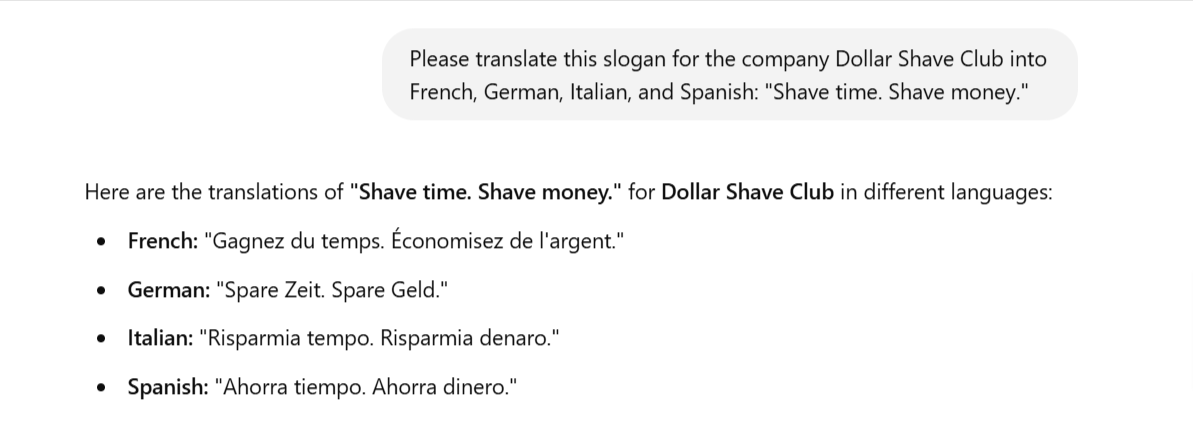
Creative copy is a huge challenge for AI translation. A slogan that’s punchy and clever in English becomes flat, literal, and uninteresting in other languages.
Another simple test recently showed how ChatGPT translations fail even at counting words correctly across multiple languages. A phrase like “Four important words to remember: you are not alone” should have been translated with exactly four key words in each language. Instead? The results varied. It’s proving that the model doesn’t actually understand structure – it just predicts likely word sequences without human reasoning.
Now imagine trusting that same system with your brand message, legal content, or product descriptions.
The takeaway is clear: AI translation services need human adaptation and localization to work across multiple languages. AI isn’t creative. It doesn’t “think” about the best way to say something – it just picks the most common way it’s been said before.
That’s why brands that blindly trust AI for translation end up with generic, awkward, or even misleading content.
The AI translation trap: scaling at the cost of connection
AI translation services absolutely help businesses scale. They speed up translation, reduce costs, and allow companies to reach global markets faster than ever before.
But there’s a trade-off.
- Over-reliance on AI leads to forgettable, uninspired content.
- Brands start to sound the same – bland, robotic, and lacking personality.
- Customers notice. And when they do, trust erodes.
And there’s another issue, and it’s one that English speakers often find hard to understand: AI translations aren’t as good in other languages as they are in English.
Because English dominates the internet, AI models are best trained in English. That means translations into other languages are more prone to grammatical errors, awkward phrasing, and sometimes outright nonsense. The problem? If you don’t speak the target language, you might never know just how bad it actually sounds.
Want to see what your AI-translated content might feel like to your audience?
Try this experiment:
- Find a simple sentence or phrase you’d use on your site. We’ve taken some from IKEA’s website: “Don’t snooze on amazing savings! Welcome to the goodnight club. Shop sleep offers”.
- Paste them into Google Translate or DeepL and translate them into any language (we’ve chosen Spanish).
- Now, take that translation and translate it back into English.

Exercise: Write a phrase into DeepL or Google Translate, translate it into any language and then back to English. This is how your content sounds to your global audience.
Whatever language you choose, chances are, what you get back won’t sound quite right.
This is how your content sounds to your global audience when you rely purely on AI translation.
So in the rush to scale, companies need to ask themselves: Is the goal just to translate content – or to actually connect with customers?
Because AI alone can’t build relationships with global audiences. That still takes a human touch.
What works? It’s not AI vs. humans - it’s AI + humans
AI translation is fast. Scalable. Cost-effective. But without human oversight, it’s also risky, generic, lifeless even.
The companies that are actually scaling successfully aren’t the ones blindly riding the AI hype train nor those who are rejecting it outright.
They’re the ones using AI translation services to speed up workflows while letting human expertise do the heavy lifting where it matters.
How AI + human translation actually works
Instead of treating AI translation services as a one-click solution, companies that get it right treat them as a starting point.
AI kicks things off with speed. Need to translate thousands of product descriptions, support tickets, or internal documents? AI can generate a first draft in seconds. It’s a game-changer for bulk content.
Human translators step in to fix what AI misses. AI can predict words, but it doesn’t understand meaning. Translators refine tone, fix unnatural phrasing, and adapt messaging so it actually resonates with different audiences.
Localization experts adjust for cultural fit. A phrase that works in English might sound weird – or completely inappropriate – in another language. Humans tweak UI/UX elements, slogans, humor, and idioms to make sure the final version actually makes sense.
AI learns from human edits. The best AI translation services improve over time. With Translation Memory, glossaries, and machine learning, businesses can cut costs and increase consistency across markets.
Who’s doing AI-assisted translation right?
The companies scaling the smart way aren’t just running everything through an AI translator and calling it a day. They’re using AI to speed up their workflows, not replace human expertise which is still needed to localize, refine, and adapt.
- E-commerce brands use AI to generate first drafts of product descriptions, but their teams refine, optimize, and adapt key messaging, especially for checkout pages, ads, and email marketing.
- SaaS companies use AI to speed up translation for help center articles and in-app support, but localization experts review and adjust UI copy and onboarding flows to make sure everything makes sense in the target language.
- Gaming companies use AI to process dialogue at scale, but localization teams step in to preserve humor, slang, and storytelling.
This hybrid AI + human translation approach helps businesses scale globally without sacrificing credibility, customer experience, or conversions.
Compare that to companies that go all-in on AI translation without human oversight. They save money upfront but end up with generic, awkward, and disconnected messaging that drives people away.
So the real question isn’t whether AI can help you scale – it’s how you choose to use it.
What’s next for AI translation services? And why are we talking about it?
AI translation services are only getting faster, cheaper, and more advanced. Will AI kill translation? Not quite. It might even increase the demand for human touch.
Because scaling globally isn’t just about being understandable in other languages. It’s about making sure those words mean something to the people reading them.
The next wave of AI translation services will focus on answering the question: How does AI translation work better over time? It will be about smart AI translation services that learn, adapt, and integrate even better with human expertise.
Where AI translation services are headed:
Smarter AI models that actually improve over time. The best AI for translation will go beyond basic word swaps. They’ll learn from edits, remember brand-specific terminology, and adapt to industry nuances.
More hybrid workflows. Businesses will shift from AI-only translation to AI-assisted human translation, where AI handles the bulk work, but humans refine and localize for tone, clarity, and cultural fit.
Greater focus on brand voice and personality. Companies will start realizing that generic AI translations don’t cut it. We’re already seeing the aversion towards AI-like content. The brands that win globally will be the ones using AI without losing their personality.
TAIA = Translations with AI Assistance
We at Taia know that AI translation isn’t just about speed, but also about delivering great translations every time. That’s why we’re building the best AI for translation that actually learns from you:
- It trains on your historical and/or ongoing Translation Memory and glossary. It will know your vocabulary from the first try. The more you use it, the better it gets, and the better it gets, the less money you have to spend in the long run.
- It marries AI speed with (optional) human oversight. If speed is your #1 priority, you’ll get it. For extra quality, there’s professional human linguists.
- It adapts to your brand and industry. Because one-size-fits-all standardized translation tools don’t work.
Want early access? Be part of the future of AI translation
We’re in beta testing right now, and we’re looking for businesses to help shape the future of AI translation services.
Want to see how our tool can translate AI faster, smarter, and more accurately than ever before? Sign up for free access and help us refine the tool to fit real-world business needs.
🔗 Join our beta testing program here.
Frequently asked questions
How does AI translation work?
AI translation uses neural machine translation (NMT) models that predict the most likely word sequences based on massive datasets. Unlike older rule-based systems, modern AI translators like ChatGPT, DeepL, and Google Translate use deep learning to generate translations that sound more natural—but they still lack true understanding of context, emotion, and cultural nuance.
Will AI replace translation jobs?
No. AI will change translation jobs, not eliminate them. While AI handles bulk content and speeds up workflows, human translators are still essential for quality control, localization, creative adaptation, and ensuring brand voice. The future is AI + human collaboration, not AI alone.
What’s the difference between AI translation and machine translation?
“Machine translation” (MT) is a broader term that includes all automated translation systems, from older rule-based and statistical models to modern neural machine translation (NMT). “AI translation” typically refers specifically to NMT-based systems that use deep learning and large language models (like ChatGPT, DeepL, or Google Translate).
Why do AI-generated translations often sound robotic or weird?
AI models predict words based on probability, not meaning. They don’t actually “understand” language—they just follow patterns from training data. This leads to translations that might be grammatically correct but lack natural phrasing, emotional nuance, and cultural context. The result? Content that feels generic, awkward, or off-putting.
Can AI translate documents accurately?
Yes and no. AI excels at translating straightforward, factual content like technical documentation, product descriptions, and simple communications. But for anything requiring creativity, brand voice, cultural adaptation, or legal precision, AI alone falls short. AI document translation works best when combined with human review and editing.
What are the biggest fails in AI translation?
Some infamous AI translation fails include Amazon Sweden’s “rape oil” (rapeseed oil mistranslated), greeting cards with vulgar Swedish terms, and IKEA phrases that sound nonsensical when back-translated. These failures happen because AI doesn’t understand context, slang, or cultural appropriateness—it just picks the most common translation from its training data.
Is AI translation better for some languages than others?
Yes. AI translation models are primarily trained on English-heavy datasets, so translations between English and major European languages (like Spanish, French, German) tend to be higher quality. Less common language pairs or languages with complex grammar structures often produce weaker results. If you don’t speak the target language, you might not realize how awkward the translation actually sounds.
What’s the best way to use AI translation services without sacrificing quality?
Use AI as a first draft, not the final product. Let AI handle bulk translation to save time and money, then have human translators or localization experts review and refine the output. Focus human effort on high-impact content like marketing copy, legal documents, and customer-facing messaging where tone and brand voice matter most.
Will AI kill the translation industry?
No—but it will transform it. Instead of replacing translators, AI will make their work more efficient by handling repetitive tasks and enabling them to focus on higher-value work like creative localization, quality assurance, and cultural adaptation. Demand for translation services is actually growing as more businesses expand globally.
What is the future of localization and translation?
The future is hybrid: AI + human collaboration. Smart companies will use AI translation services to speed up workflows while keeping humans in the loop for quality, creativity, and cultural fit. AI will continue improving through machine learning, Translation Memory integration, and industry-specific training—but the brands that win globally will be those that don’t sacrifice personality and connection for speed.

Project Manager & Content Writer
Eva is a project manager and occasional content writer who has honed her skills in marketing localization since 2019. Like most millennials, she's a Potterhead. She loves traveling and collecting bookmarks, used books, and vinyl.