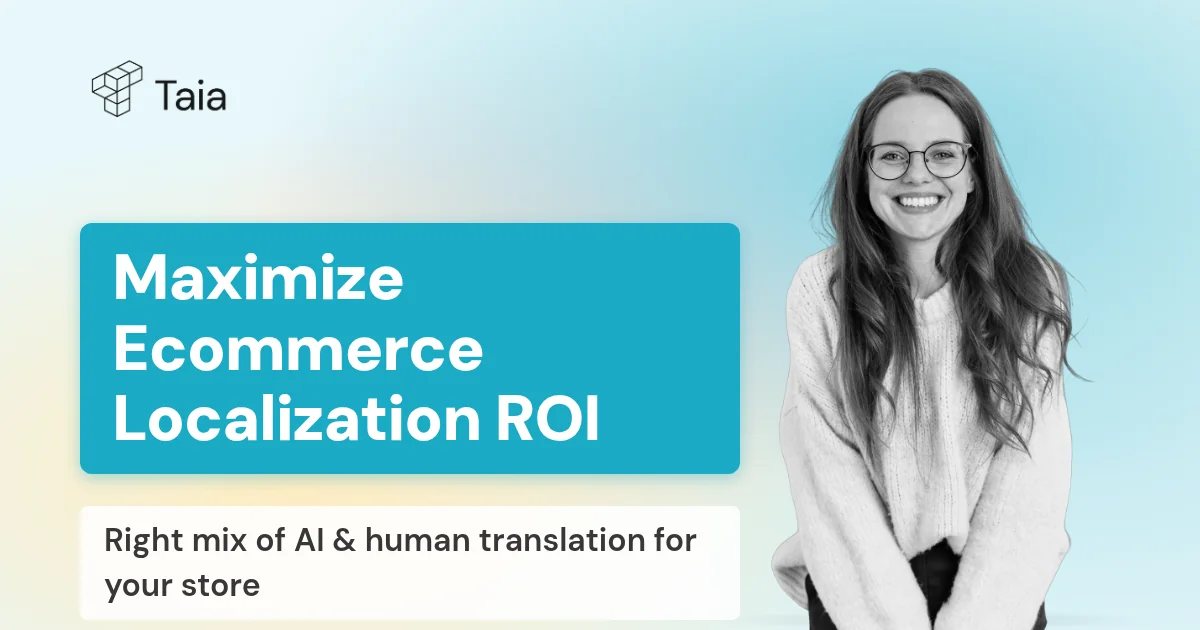
Expanding into cross-border eCommerce is an exciting step for any brand, but the cost of eCommerce localization can feel like a roadblock, especially when you’re going multilingual.
You know your customers need content in their own language, but translating an entire store? That gets expensive – fast.
We’ve seen this scenario play out hundreds of times. eCommerce localization managers come to us excited about their new venture, only to feel overwhelmed when they see a $5,000 or $10,000 localization quote that blows their budget. They start wondering, “Do we really need to translate everything?” “Can we just use AI?”
Yes Gary, yes you can.
But picture this: Someone halfway across the world is searching for a high-end skincare product. They land on your site, intrigued by your sleek branding and glowing reviews. But then they read the description. The wording is a little clunky. The ingredients list is oddly phrased. It’s not outright wrong, just… off. And when it comes to putting something on their skin, “off” is not exactly the sensation they’re looking for.
And they’re not alone.
If It Sounds Wrong, It Sells Wrong
67.9% of the world’s population – 5.56 billion people – are now online. But only 25.9% of them use English. Just like you wouldn’t settle for sloppy, unclear copy in English, why should your customers in other markets?
A bad translation isn’t just a language issue – it’s a credibility issue. eCommerce localization is about giving your international customers a seamless shopping experience in a language they trust.
And if you’re going to invest in it, you want to do it in a way that maximizes impact without draining your budget.
The secret? You don’t need cheap localization – you need scalable localization. One that prioritizes human translation where it matters and leverages AI where possible to cut costs without cutting quality.
The good news is, you don’t have to figure this out on your own. We’ve helped several multilingual eCommerce stores navigate this process, find the right balance, and expand internationally without overspending.
This article will walk you through:
✔️ The most common localization mistakes online stores make
✔️ How to combine AI & human translation to keep localization within your budget
✔️ How to prioritize your content for scaling, affordability and maximum localization ROI
Let’s break it down.
The Localization Mistakes That Can Cost You Thousands
Many businesses fall into the same localization traps:
- Relying only on AI translation: It’s fast and cheap, sure, but it can result in unnatural, low-quality translations that drive customers away. Studies show that 40% of consumers won’t buy from a website if the language is unclear or poorly translated.
- Using only human translation: Precise and polished, but slow and expensive – scaling becomes almost impossible for large product catalogs.
- Translating everything the same way: Not all pages are equally important, yet many businesses spend the same budget on a product that sells twice a year as they do on their bestsellers.
- Ignoring multilingual SEO: Just because a page is translated doesn’t mean it will rank in search engines. Localized keyword optimization is crucial for organic traffic. And with less than 30% internet users speaking English, relying solely on English content means leaving a huge portion of the market untapped.
Human translation isn’t just about accuracy, but also about visibility. Search engines prioritize localized keywords, which is why businesses that speak their customers’ language dramatically increase their likelihood of making a sale (Harvard Business Review).
The businesses that win in international markets aren’t the ones that translate everything.
They’re the ones that translate – you’ve guessed it – smart.
How Taia Helped an eCommerce Store Optimize Localization Costs
One eCommerce retailer we worked with was ready to expand into multiple new markets. Their plan? Localize their entire eCommerce store.
Then they saw the price. Their budget was $3,000. Their quote? $6,000.
They weren’t ready to abandon localization, but they also couldn’t justify doubling their budget. Like many businesses, they thought their only options were:
- Find a cheaper provider (and risk poor-quality translations).
- Use AI translation for everything (and risk bad user experience and lost conversions).
But we showed them a third option: a hybrid approach that made localization scalable and improved their localization ROI.
- We helped them identify the 10% of content that actually drives revenue – best-selling products, checkout pages, and core marketing content – and allocated AI-assisted human translation with revision to those pages.
- Our custom AI model learned on that 10%, building a Translation Memory tailored specifically to this project.
- The other 90% – bulk product descriptions, FAQs, and secondary pages – were translated using now smarter TM, with their internal team reviewing key details.
With this localization strategy, they stayed within budget, successfully launched in multiple new markets, and saw an increase in international sales.
This is what scalable localization looks like.
Why That ‘Perfectly Fine’ AI Translation Might Be Costing You Sales
Most eCommerce businesses start their localization projects with AI translation tools like Google Translate, DeepL, or Weglot, thinking they’ve found a simple, low-cost solution. And at first glance, it seems to work – content gets translated, the pages are live, everybody’s happy.
If they’re lucky, at some point they’ll meet a native expert who will point out their product descriptions sound robotic, their carefully crafted brand voice is quiet, and their checkout page feels off (again, not a target sentiment for customers).
If they’re not that lucky, chances are they’ll be left scratching their heads wondering why their best-selling product is not working in Norway as well as it is in Germany.
The language might not even be incorrect, just awkward enough to make customers hesitate before clicking “Buy.”
And why wouldn’t they? Online shopping relies on trust. Customers have been burned before by sketchy websites. If your translated content sounds even slightly off, it raises red flags. Is this site legit? Will my order even arrive? A simple translation hiccup can turn a ready-to-buy visitor into a lost sale.
Of course, that doesn’t mean AI translation is useless – far from it. AI-driven translation is an incredible tool for scaling localization ROI efficiently, but only when used in the right places and with the right technology.
Where Machine Translation Actually Works Well
Machine translation excels when speed and volume matter more than perfect prose.
- Large product catalogs: If you have thousands of SKUs, manually translating every product description isn’t just impractical – it’s impossible. AI speeds up bulk translation without breaking the bank.
- User-generated content: Reviews, FAQs, and testimonials can be auto-translated so international customers can engage with real feedback.
- Frequent updates: Inventory changes, promotions, and price adjustments shouldn’t need human intervention every time. AI can be used to keep things consistent across all languages.
But here’s the catch: Not all AI translation tools are created equal.
AI translator tools like DeepL and Weglot can translate words alright, but they don’t translate with memory, context, or brand consistency.
- They don’t support many file formats (in comparison, Taia supports 65+ file formats).
- They don’t remember past translations, meaning you’ll likely have to translate the same content over and over, or create your own translation databases manually.
- In basic versions, they don’t offer a glossary, so your key product terms, brand voice, and technical language aren’t consistently applied.
Which is why businesses come to Taia’s Translation Management System when they need a localization approach that actually works for eCommerce.
Unlike standard machine translation tools, Taia’s AI learns from your previous translations and stores them in an automatic translation memory, applies your industry-specific glossary, and translates entire documents with context. That means:
✔ Your brand voice stays consistent across every language
✔ Your product descriptions don’t read like they were pieced together sentence-by-sentence
✔ The more you translate, the more you save – Translation Memory works with and for you
This is how machine translation should work. Not as a generic, one-size-fits-all tool, but as a scalable solution that gets smarter over time, for each online store separately.
The Best eCommerce Stores Combine AI & Human Translation
The best multilingual eCommerce stores don’t pit AI and human translation against each other. They use both strategically:
- About 10% of content (best-selling product pages, checkout pages, and marketing materials) should be fully translated and reviewed by expert linguists.
- These translations are used to feed an AI model the knowledge about your specific project.
- The other 90% – bulk product descriptions, FAQs, and lower-priority content – can be translated using that AI, cutting costs dramatically.
This approach delivers:
✅ Professional quality where it matters most (high-traffic, high-conversion pages)
✅ Speed and affordability for bulk content
✅ Consistency across your entire store through Translation Memory
✅ Scalability as you expand to more markets
How Taia Helps You Maximize Your Localization ROI
At Taia Translations, we give eCommerce businesses the flexibility to mix AI-powered translation, human expertise, and Translation Memory with tailored pricing, so you only pay for what actually matters.
- AI-only translation for bulk content that needs speed and efficiency.
- Human translation, review & editing for content that requires precision and cultural adaptation.
- Fully automated Translation Memory that reduces costs over time by storing and reusing previous translations.
- Custom glossaries to maintain brand consistency across all languages.
Ready to scale your eCommerce store globally without overspending?
Get started with Taia or talk to our team today.
Frequently Asked Questions
What is eCommerce localization, and why does it matter?
eCommerce localization is the process of adapting your online store’s content, product descriptions, checkout flow, and customer experience to meet the linguistic and cultural expectations of customers in different markets. It matters because 67.9% of the world’s population is online, but only 25.9% speak English. Localization removes language barriers and builds trust, which directly impacts conversion rates and sales.
Can I use AI translation for my entire eCommerce store?
You can use AI translation for your entire store, but you shouldn’t. AI translation works well for bulk content like product descriptions and FAQs, but customer-facing content (checkout pages, marketing copy, best-selling products) needs human review to maintain quality and brand voice. 40% of consumers won’t buy from a website with unclear or poorly translated language. The smartest approach is a hybrid model: human translation for high-impact content (10%) and AI for the rest (90%).
What’s the smartest way to combine AI and human translation?
The smartest hybrid approach is to: (1) Identify the 10% of content that drives 90% of revenue (best-sellers, checkout, marketing), (2) Use professional human translation with AI assistance for that critical 10%, (3) Let these translations train your Translation Memory, (4) Use AI translation powered by your custom Translation Memory for the remaining 90%, (5) Have your internal team review key details. This approach keeps you within budget while maintaining quality where it matters most.
What are the biggest localization mistakes eCommerce stores make?
The biggest eCommerce localization mistakes include: relying solely on generic AI translation (leads to awkward wording that kills trust), using only human translation for everything (too expensive and slow to scale), translating all content the same way (wasting budget on low-priority pages), and ignoring multilingual SEO (translated pages won’t rank without localized keywords). The solution is strategic prioritization and a hybrid approach.
How does Translation Memory actually save money?
Translation Memory (TM) saves money by storing all your previous translations and automatically reusing them in future projects. When you translate “Add to Cart” once, TM remembers it and applies it everywhere else - no need to retranslate or pay twice. The more you translate, the more you save. TM also maintains consistency across your entire store, ensuring your brand voice stays uniform in every language.
What’s wrong with using DeepL or Weglot for my eCommerce store?
DeepL and Weglot are general-purpose translation tools, but they have limitations for eCommerce: they don’t support many file formats (Taia supports 65+), they don’t build Translation Memory automatically (you have to create your own databases manually), they don’t offer industry-specific glossaries (so key product terms aren’t consistently translated), and they translate sentence-by-sentence without full document context. This leads to inconsistent brand voice and repetitive work.
How is Taia’s AI translation different from DeepL or Weglot?
Taia’s Translation Management System is purpose-built for business translation. Unlike DeepL or Weglot, Taia: learns from your previous translations with automatic Translation Memory, applies your custom glossary to maintain consistent brand terminology across all content, translates entire documents with context (not sentence-by-sentence), supports 65+ file formats, and combines AI speed with optional human review for quality. The more you use it, the smarter and more cost-effective it becomes.
How do I know which pages need high-quality human translation?
Prioritize human translation for: best-selling product pages (where most revenue comes from), checkout and cart pages (where conversions happen), homepage and category landing pages (first impressions matter), marketing campaigns and email templates (brand voice is critical), and legal pages like Terms of Service and Privacy Policy (accuracy is required). Use AI translation with light review for: bulk product catalogs, FAQs and help center articles, user reviews, and frequently updated content like promotions.
How can I maximize my eCommerce localization ROI?
Maximize eCommerce localization ROI by: (1) Using data to prioritize high-traffic markets first, (2) Applying a hybrid translation model (10% human, 90% AI), (3) Building Translation Memory from day one to reduce costs over time, (4) Implementing glossaries for consistent terminology, (5) Optimizing for multilingual SEO with localized keywords, (6) Testing and iterating based on conversion data. The key is strategic prioritization - invest quality where it drives sales, use AI where it saves money.

Project Manager & Content Writer
Eva is a project manager and occasional content writer who has honed her skills in marketing localization since 2019. Like most millennials, she's a Potterhead. She loves traveling and collecting bookmarks, used books, and vinyl.