So, you’ve decided to go global. Your product is scaling, your marketing team is buzzing with ideas, and you’ve got a localization budget. Great!
But here’s the kicker: most businesses we work with show horrible examples of localization strategy. They fumble it so badly that they either burn money on low-impact content or wreck their brand’s credibility with bad translations.
Successful global expansion isn’t just about translation; it’s about glocalization (a term coined in 1980 in Harvard Business Review that we absolutely love). It’s the fine balance between thinking big and adapting locally, ensuring that your content resonates just as well in a quaint French village as it does in New York.
Done right, glocalization makes your brand feel native everywhere. Done wrong? You’re either overspending on content that doesn’t matter or underinvesting in the content that does.
We get it – localization can get complicated. That’s why a well-defined (and ultimately, profitable) localization strategy cuts through the noise and shows you how to prioritize what matters. Think of this as your cheat sheet for smarter, more cost-effective localization. Because throwing money at translation without a strategy? That’s just expensive wishful thinking.
Localization Strategy is Just a Fancy Name for Prioritization
As professional translators well-versed in AI, we’re not afraid to say this: not all content deserves the same localization effort. Some content is mission-critical, while other pieces are just nice to have in another language. The problem is, companies often treat everything as equally important – and that’s a costly mistake.
Imagine you’re a SaaS company launching in Japan. Your landing page needs to convert, your UI must be seamless, and customer support FAQs should be crystal clear – these are mission-critical and worth the high investment in professional translation to ensure accuracy, cultural adaptation, and user trust. But does every single blog post in your archive need the same treatment?
This is where opportunity cost comes into play. Every dollar spent on translating low-impact content is a dollar that could have been used to refine high-converting pages, improve user experience, or expand into another key market. Businesses that fail to prioritize their localization efforts often spread their budgets too thin, diluting the impact of their most critical content. Instead of getting the highest return on investment, they end up with flawless translations in places that barely move the needle – while potentially neglecting content that actually drives revenue.
On the flip side, cutting costs in the wrong places – often by over-relying on AI – can be just as damaging. While AI-assisted translation is a great way to speed up workflows and reduce costs, it’s not always enough for high-stakes content. Using AI for mission-critical materials like product descriptions, UI, or customer-facing messaging without human oversight can lead to confusing text, cultural missteps, and a lack of brand consistency. A poorly translated onboarding experience or an awkwardly worded CTA might save money upfront, but it could cost far more in lost sales and disengaged users.
AI has its place in a smart localization strategy, but businesses that fail to balance automation with human expertise risk compromising quality where it matters most – ultimately weakening their international success.
The Localization Strategy Pyramid: A Smarter Way to Prioritize
Companies that approach localization strategically allocate their budget where it delivers the highest ROI. Instead of blindly translating everything, they segment their content into priority levels and match it with the right level of localization effort. This ensures that they get the best quality where it matters most, without overspending on materials that don’t justify the cost.
But how do you know which content to prioritize? Well, just look at your data and you will see what drives the most revenue, leads, or traffic.
To make things easier, we’ve created a simple four-tier framework to help businesses allocate resources wisely – focusing premium efforts where they matter most while leveraging AI and automation for lower-priority content.
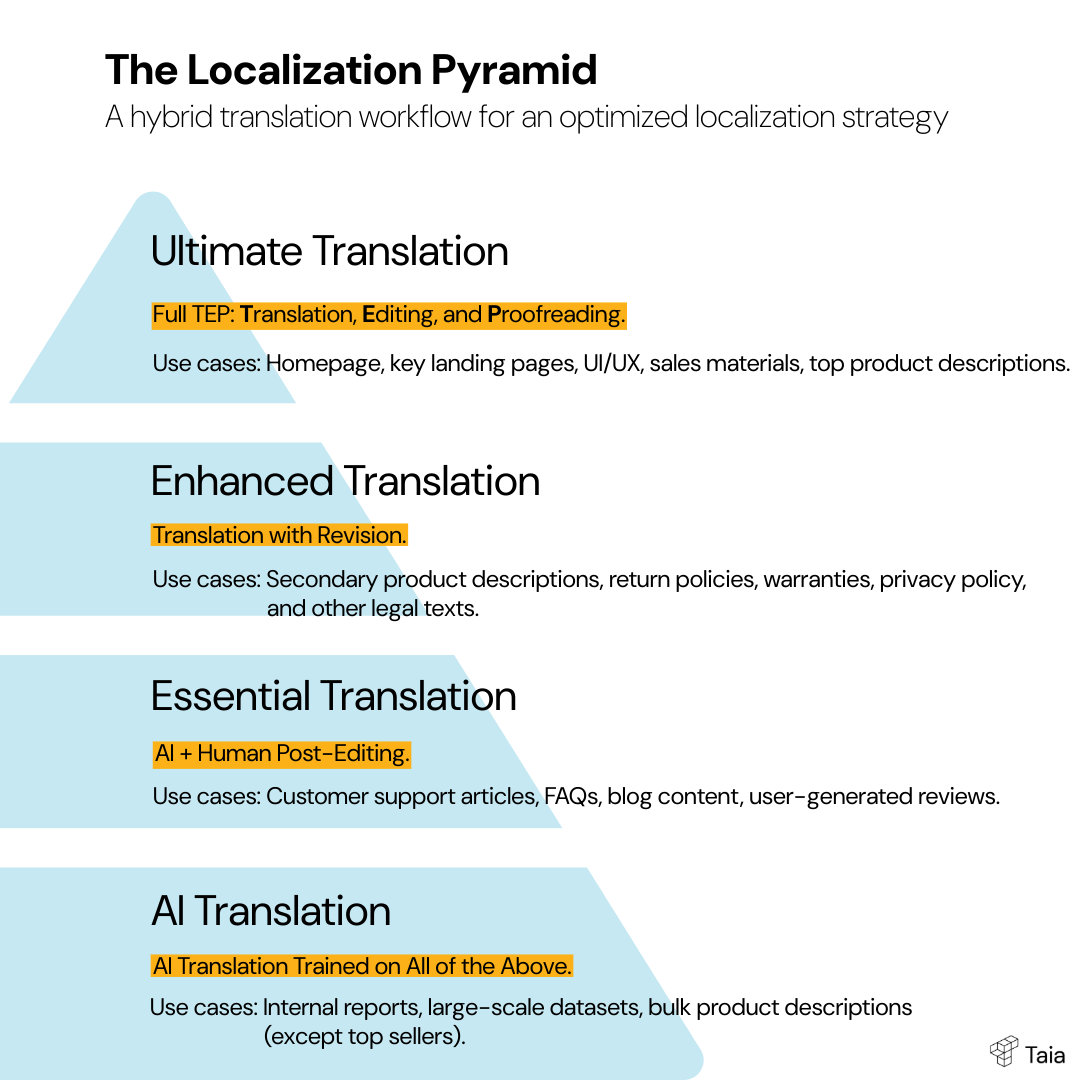
Tier 1: Ultimate Localization for High-Impact, Revenue-Driving Content
Full TEP: Human translation, editing and proofreading.
When it comes to localization, some content is simply too important to get wrong. This is the content that directly affects conversions and user experience – if it fails, your expansion fails. Investing in professional human translation, SEO, revision, and proofreading ensures accuracy, cultural adaptation, and a seamless customer journey.
What falls into this category?
- Website homepage & key landing pages – Your localization strategy must prioritize these for a flawless first impression.
- UI/UX for software & apps – A confusing interface or poorly translated error messages can lead to user frustration and churn.
- Product descriptions for key products – Customers need clear, compelling product information in their native language.
- Sales & marketing assets – Ads, brochures, and videos require precise messaging to persuade and convert.
Example: Imagine you’re an AI-powered SaaS company expanding to Germany. Your onboarding flow is critical – if users encounter awkward translations or unclear instructions, they may abandon your platform before they even get started. A poorly localized CTA can tank conversion rates, making all your marketing efforts go to waste. This is where you set a localized marketing strategy and go all-in on quality, ensuring your most valuable content is handled with precision.
Tier 2: Enhanced Localization for Crucial But Not Core Content
Human translation and revision.
Not all content needs premium, high-cost localization plans, but some materials still require precise translation and revision to maintain credibility and user trust. Enhanced localization strikes a balance between quality and efficiency, ensuring important content is clear, accurate, and aligned with your brand’s voice.
What falls into this category?
- Customer-facing legal documents – Terms of service, contracts, and privacy policies must be legally sound and culturally appropriate.
- Important product information – Return policies, product warranties, and other legal texts.
- Secondary product descriptions – Important for marketing but not as critical as core product pages.
Example: A manufacturing company expanding to China needs to translate its internal safety manuals for its new workforce. Since accuracy is crucial but creative adaptation isn’t, AI-assisted translation with human revision ensures clarity and reliability – while keeping costs reasonable.
Tier 3: Essential Translation for Informative Content
AI + Human Post-Editing.
Some content must be understandable but doesn’t require meticulous cultural adaptation. This is where a scalable localization strategy makes all the difference – using AI-assisted translation with human post-editing to keep costs low while still ensuring accuracy.
What falls into this category?
- Customer support knowledge bases – Helps international users find answers fast.
- Low-priority blog content – Informational but not mission-critical for conversions.
- User-generated content (reviews, testimonials) – Often high in volume, requiring scalable solutions. We see this often in e-commerce.
Example: A global fintech firm with thousands of knowledge base articles uses AI translation to make information accessible across regions. While AI speeds up the process, human post-editing ensures key details remain accurate.
Tier 4: Automatic Translation for Bulk Content
AI-only translation.
For large-scale, low-priority content, full human translation isn’t practical. A cost-effective localization strategy leverages AI-only translation for scalability – perfect for cases where understandability is enough and stylistic perfection isn’t required.
What falls into this category?
- Internal reports & communications – Helps international teams stay informed with quick, automated translations of reports, memos, and corporate updates.
- Large-scale datasets – Enables businesses to process and analyze multilingual data efficiently without the need for manual translation.
- Bulk product descriptions for e-commerce – Only top-selling products (around 10%) need full translation, while AI can efficiently handle the rest for scalability.
Example: A global fintech firm has an internal knowledge base with thousands of articles. AI translation allows employees worldwide to access information without the high cost of human translation.
Localization Strategy Table: AI vs. Human vs. Hybrid Translation
| Content Type | Recommended Approach | Why This Works | Best Tool |
|---|---|---|---|
| Homepage & Landing Pages | Full TEP (Translation + Editing + Proofreading) | First impressions matter. High-converting pages need perfect localization. | Professional Services |
| UI/UX & Software Strings | Human Translation + Review | Users interact with this daily. Errors = frustration and churn. | TMS with Glossary |
| Marketing & Sales Materials | Full TEP | Brand voice and persuasion require cultural nuance and precision. | Professional Services |
| Legal Documents | Human Translation + Legal Review | Compliance and accuracy are non-negotiable. | Professional Services |
| Product Descriptions (Top Sellers) | AI + Human Review | Balance speed with quality for high-revenue items. | AI Translator + Review |
| Support Knowledge Base | AI + Light Post-Editing | Users need answers fast. AI provides scale, humans ensure clarity. | TMS with Translation Memory |
| Blog Content | AI + Spot-Check | Informational content doesn’t need perfection, just comprehension. | AI Translator |
| Internal Communications | AI-Only | Speed matters more than style for internal updates. | AI Translator |
| Bulk Product Catalogs | AI-Only | Thousands of SKUs need quick translation for discoverability. | AI Translator |
Key Takeaway: Use Taia’s Translation Management System to manage all tiers in one platform. Our hybrid approach lets you choose the right level of service for each content type, with Translation Memory and custom glossaries ensuring consistency across all translations.
Final Thought: Localization Is an Investment, Not an Expense
Some companies see localization as just another expense. But the ones who get it? They know it’s the key to reaching their international goals, growing their customer base, and making a real impact in new markets.
If you’re still reading, you probably already have some idea which part of your content comes at the top of the localization strategy pyramid, and which comes at the bottom.
The only thing left for you to do is to get a super-fast quote on your projects.
At Taia, we offer four distinct tiers tailored to your content needs – from AI-only translations for quick, large-scale tasks to full-service professional localization (translation, editing, and proofreading) for mission-critical content.
Getting started is effortless:
- Create an account in seconds – no credit card, billing info, or verification needed until you decide to actually place an order.
- Upload your documents – our system instantly analyzes your content and provides a tailored quote.
- Choose the service tier that fits your needs – whether it’s AI-powered speed or expert human refinement, you’re in control.
Get started with Taia or talk to our team.
Frequently Asked Questions
How can I reduce localization costs without sacrificing quality?
Use a tiered localization strategy. Invest in full human translation for high-impact content (homepage, UI, top products), and use AI translation with light review for bulk content. Leverage Translation Memory to automatically reuse previous translations and reduce costs over time. Focus 80% of your budget on the 20% of content that drives 80% of revenue.
Which types of content should I prioritize to maximize localization ROI?
Prioritize content that directly impacts conversions: homepage and landing pages, UI/UX for software, product descriptions for best-sellers, checkout flows, and marketing materials. These are Tier 1 in our localization pyramid. Use data to identify which pages drive the most traffic and revenue, then allocate premium translation budget there.
How can I improve AI translation quality?
Improve AI translation quality by: (1) Building a Translation Memory from high-quality human translations, (2) Creating custom glossaries with your brand terminology and technical terms, (3) Providing full document context (not sentence-by-sentence translation), (4) Adding human post-editing for customer-facing content, (5) Using a purpose-built Translation Management System that learns from your previous translations, not generic tools like Google Translate.
Is AI translation good enough for professional use?
Yes, but with conditions. AI translation works well for: internal communications, bulk product catalogs, support documentation, and low-priority blog content. It’s NOT sufficient alone for: UI/UX, marketing materials, legal documents, or high-converting pages. The best approach is hybrid: use AI for speed and scale, add human review for quality and brand voice. Taia’s platform lets you choose the right mix for each content type.
What is hybrid translation, and when should I use it?
Hybrid translation combines AI speed with human expertise. AI handles the initial translation, then professional linguists review and refine for accuracy, cultural adaptation, and brand consistency. Use hybrid translation for: Tier 2 content (customer-facing but not core), Tier 3 content (informative materials), and when you need to balance quality with budget. It’s ideal for companies scaling internationally who can’t afford full human translation for everything but need better quality than AI-only.
What’s the difference between localization and translation?
Translation converts text from one language to another. Localization adapts your entire user experience for a specific market – including translation, cultural adaptation, UI/UX changes, currency and date formats, local compliance, and market-specific messaging. Translation is a component of localization. A localization strategy determines which content to translate, how deeply to localize it, and what level of quality investment each content type deserves.

Project Manager & Content Writer
Eva is a project manager and occasional content writer who has honed her skills in marketing localization since 2019. Like most millennials, she's a Potterhead. She loves traveling and collecting bookmarks, used books, and vinyl.