If you’ve ever had to rewrite a translation because it “just didn’t sound like us,” you need a style guide.
It’s one of the most common problems in localization — the translators do their job just fine, but the end result feels off. Maybe the tone is too formal or the phrasing is not natural…
That’s not their fault. It’s what happens when your brand voice isn’t clearly defined for each market.
A translation style guide (or localization style guide) aims to solve this. It gives translators, reviewers, and even AI (mainly LLM) tools clear rules for tone, formality, and style — so your brand sounds consistent and natural in every language.
You’ll save hours of review time, avoid awkward tone mismatches, and make sure your brand always sounds like your brand — no matter who translates it.
What exactly does a translation style guide do?
A translation style guide is a short document that tells translators and editors how your brand should sound — in every language.
It defines things like tone of voice, level of formality, punctuation, and formatting. Basically, all the small choices that decide whether your content sounds friendly, professional, or robotic.
If your glossary covers what key terms mean, and your translation memory stores how you’ve translated them before, your style guide explains how to use them. It’s what ties accuracy and tone together.
A localization style guide goes even further. (Learn about the difference between translation and localization here.) It includes cultural and regional preferences — how polite or direct to be, whether humor fits, and how to handle dates, currencies, or measurements.
So why do you need one?
Because even the best translators can’t read your mind.
Without clear direction, every linguist, reviewer, or AI tool will make their own judgment calls — and your tone will start shifting across markets, pages, or even paragraphs.
A good style guide prevents that by:
- Keeping your tone consistent – no more switching between friendly and formal mid-sentence.
- Reducing rework – translators know your preferences from the start, so you don’t waste time rewriting.
- Improving LLM output – when your LLM of choice (ChatGPT, Claude) follows your guide, it’s more likely to stay true to your voice.
- Speeding up onboarding – new linguists can align with your brand tone in minutes.
In short: it’s the easiest way to make sure every piece of localized content — human or AI-translated — still sounds like you want it to sound.
And yes — it makes sense to use a style guide for translation even if you’re already working with experienced linguists or advanced tools. It keeps tone, terminology, and formatting consistent from day one instead of relying on everyone’s interpretation of “what sounds better.”
Ready to work with professional translators who follow your style guide? Our network of ISO 17100-certified linguists specialize in maintaining brand voice across languages — using your style guide as their foundation.
What should a good translation style guide include?
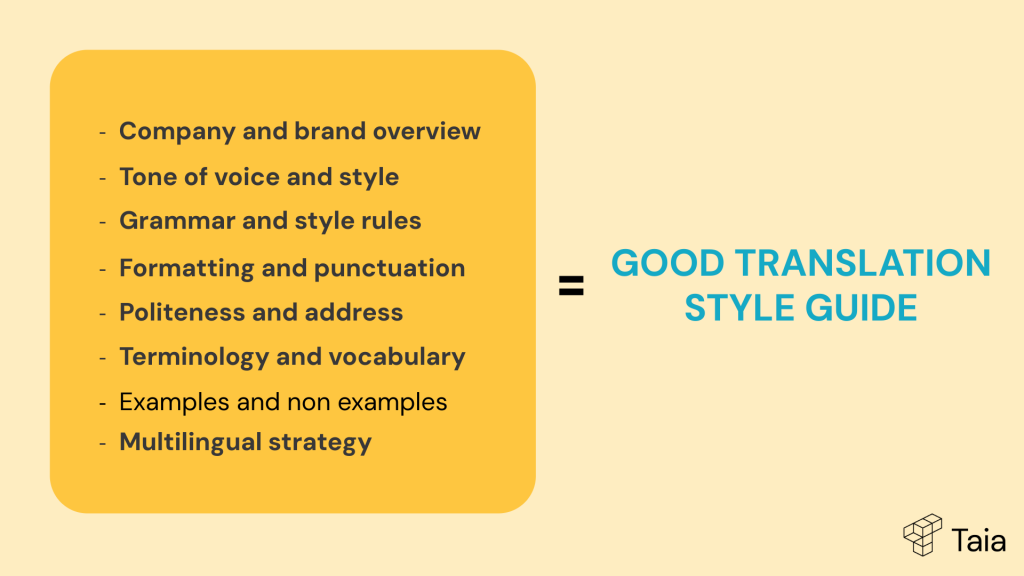
A good style guide doesn’t need to be long or complicated. It just needs to answer one question: “How should our brand sound in other languages?”
Here’s what every effective translation or localization style guide should include:
1. Company and brand overview
Start with the basics: who you are, what you do, and what makes you different. This gives translators context for every decision they’ll make.
Include your mission, your audience, and your brand personality. Are you the disruptor? The trusted expert? The fun alternative?
Pro tip: If you already have a brand style guide for design and marketing, use that as your foundation. Your translation style guide should complement it, extending those brand standards to how you sound in other languages.
2. Tone of voice and style
This is the heart of your guide. Define how your brand speaks.
Are you formal or casual? Direct or diplomatic? Playful or serious?
Give clear examples:
- ✅ “Let’s dive in” (casual, inviting)
- ❌ “We shall proceed to examine” (too formal)
3. Audience and cultural considerations
Who are you talking to? And how do they expect to be talked to?
Your style guide should clarify:
- Regional preferences (UK vs US English, European vs Latin American Spanish)
- Cultural sensitivities (humor, directness, formality levels)
- Industry-specific expectations
4. Grammar and style rules
Cover the practical stuff:
- Active vs passive voice
- Sentence length
- Use of contractions
- Gendered language preferences
- Capitalization rules
5. Terminology and vocabulary
Link to your glossary, but also note:
- Words to avoid
- Preferred synonyms
- Industry jargon (use it or simplify it?)
- Brand-specific terms that should never be translated
6. Formatting and punctuation
Define how you handle:
- Numbers, dates, currencies
- Lists and bullet points
- Quotation marks and punctuation
- Headings and subheadings
- Abbreviations and acronyms
These decisions should align with your overall brand standards to maintain consistency across all customer touchpoints.
7. Politeness and address
How do you address your audience?
- Formal “you” vs informal “you” (important in many languages)
- First person (we/our) or third person (the company/its)?
- Level of directness
8. Examples and non-examples
Show, don’t just tell. Include:
- Sample translations that nail your tone
- Common mistakes to avoid
- Before/after comparisons
9. Multilingual strategy
If you’re translating into multiple languages, note:
- Source language (usually English)
- Priority markets and languages
- Cascade strategy (translate from one language to another)
- Regional variations to maintain
Skip the setup — get your free translation style guide template
Creating a style guide from scratch takes time — and honestly, you don’t need to reinvent it.
We’ve already built the framework for you.
Our Translation & Localization Style Guide Template includes everything you’ve just read about — tone, terminology, formatting, cultural notes, and even sample examples. It’s the same structure our own linguists use when onboarding new clients.
Get your free translation style guide

You’ll have a ready-to-use guide in under an hour — and your translators will thank you later.
Frequently asked questions
What is a translation style guide?
A translation style guide is a document that defines how your brand should sound in different languages. It covers tone of voice, formality, punctuation, and formatting rules to ensure consistency across all translated content.
What’s the difference between a translation style guide and a localization style guide?
A translation style guide focuses on language and tone. A localization style guide goes further by including cultural preferences, regional variations, and how to adapt content for specific markets (like dates, currencies, and humor).
Why do I need a style guide if I already have a glossary or translation memory?
A glossary tells translators what terms mean. Translation memory shows them how you’ve translated before. A style guide explains how to use them — the tone, context, and brand voice that ties everything together.
How long does it take to create a translation or localization style guide?
With our free template, you can have a working style guide in under an hour. Just fill in your brand specifics, add examples, and you’re done. Building one from scratch could take a few days.
How often should a style guide be updated?
Review it every 6-12 months or whenever your brand evolves. If you launch in new markets, add new products, or shift your tone, update your guide to reflect those changes.

Project Manager & Content Writer
Eva is a project manager and occasional content writer who has honed her skills in marketing localization since 2019. Like most millennials, she's a Potterhead. She loves traveling and collecting bookmarks, used books, and vinyl.