If you’ve ever Googled “AI vs machine translation,” you’ve probably left more confused than when you started. Everyone’s slapping “AI-powered” on everything these days – including translation tools.
But are they all using the same kind of AI?
Spoiler: no.
Is AI translation just a fancy word for neural MT? Is machine translation outdated? And why does ChatGPT for translation sound amazing… until you actually try it?
Well, here’s the short version:
- All neural machine translation is machine translation.
- All AI translation is machine translation, too.
- Therefore, all neural machine translation is AI translation.
- But not all AI translation is neural machine translation – some of it is generative AI (see Fig. 1 below).
It’s a bit of a mess created by terminology confusion, so we’re here to make it easier to understand.
This guide breaks it all down: what each term means, how the systems work under the hood, and which tools use each one.
TL;DR — AI translation vs. machine translation vs. neural MT
Think of it this way:
- Machine translation is the umbrella term — it’s been around since the 1950s.
- AI translation is a part of MT.
- Neural MT is what powers AI translation tools like Taia, Google Translate, and DeepL today.
- GenAI translation is the new kid on the block, using generative AI like GPT-4 to go beyond simple word-swapping.
What translation technology does Taia’s AI Translator use?
With Taia’s AI Translator, you’re getting a hybrid setup that blends all three – neural models, AI-driven automation, and human validation when you need it. Right now, our engine is powered by advanced neural MT — fast, consistent, and secure — without relying on OpenAI or other open models, so your data stays private. Large language model (LLM) integration is on our roadmap, and with new open-source options emerging, we’ll be adding it soon in a way that’s both high-quality and privacy-first. (Think: optional content enhancement.)
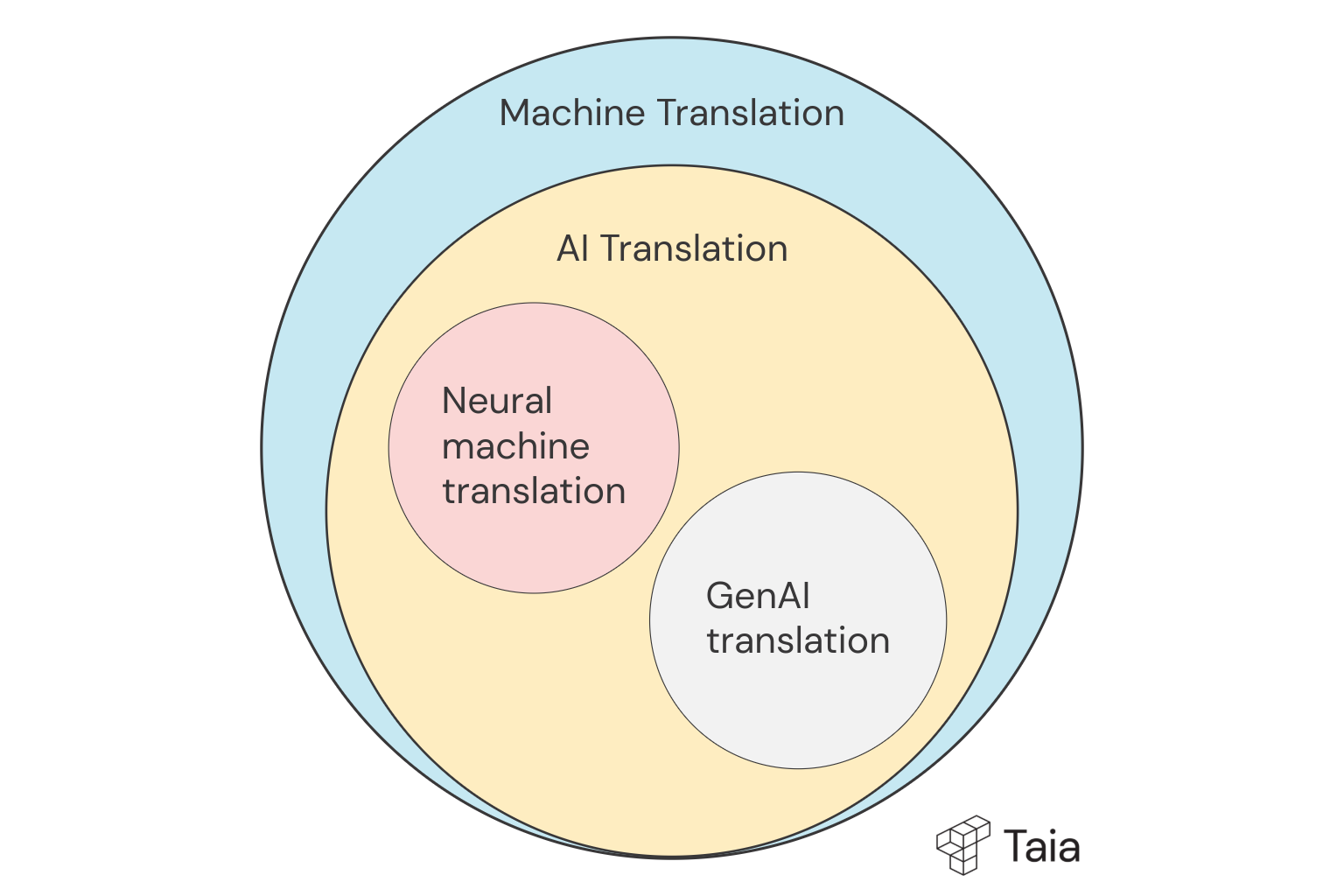
Fig. 1 — The relationship between machine translation, AI translation, and neural MT
What is machine translation?
Machine translation (MT) is the umbrella term for any translation performed by software without human input. It’s been around since the 1950s – and yes, the early results were just as rough as you’d imagine. From rule-based systems to statistical models to today’s AI-driven neural networks, the tech has come a long way.
At its core, machine translation is about converting text from one language to another using algorithms. But the way those algorithms do the translating has changed a lot over the years:
-
Rule-based MT (RBMT) relied on dictionaries and grammar rules – like a multilingual grammar nerd with zero flexibility. These systems were used for decades but struggled with idioms and real-world sentence structure.
-
Statistical MT (SMT), most famously used by Google Translate in the early 2000s, learned from large bilingual corpora to translate phrases based on probabilities. A major leap forward – but remember how we used to make fun of the gibberish it delivered? Actually, it’s still giving us enough material to dedicate a whole subreddit to it.
-
Neural MT (NMT) came next and revolutionized the field. NMT uses deep learning to consider the whole sentence context – more on that in the next section.
💡 Did you know? Taia’s AI translator takes into consideration the context of your whole document, not just sentence by sentence – supporting 65+ file formats.
But here’s the thing: “machine translation” doesn’t always mean “neural” or “AI-powered.”
Some tools still rely on older SMT engines, especially in niche domains or less-funded products. In fact, hybrid setups combining statistical, rule-based, and neural models are still used in some cases.
Where rule-based or statistical machine translation still show up today:
- Chrome’s built-in “Translate this page” feature (a simplified NMT hybrid based on Google Translate)
- Legacy enterprise systems still running SMT under the hood
What is neural machine translation (and why it changed everything)
If machine translation was the prototype, neural machine translation (NMT) is the upgrade that actually works in the real world. NMT is the AI-powered system behind most modern translation tools – including Taia, DeepL, and Google Translate (in its current form).
So… what is it, exactly?
Neural machine translation uses deep learning models – specifically, neural networks – to translate full sentences at once instead of chopping them into disconnected phrases. This gives NMT the ability to understand context, not just vocabulary.
The first breakthrough came in 2014–2016 when researchers replaced the old “phrase-by-phrase” logic with a system that could encode an entire sentence and generate a more fluent translation in one go. Most systems now use the Transformer architecture (yes, the same one behind ChatGPT), which excels at handling long-range dependencies and word order.
Want to geek out? The paper that changed everything: “Attention Is All You Need” (Vaswani et al., 2017)
Why neural MT works better
- It looks at the whole sentence – not just fragments – to understand meaning.
- It can handle complex grammar and reordering (like German verbs at the end).
- It produces translations that sound more human, less robotic.
Where neural MT is used today
- Taia’s hybrid AI translation tool, which blends neural models with translation memory and human refinement
- DeepL (one of the most fluent NMT tools on the market, although users report a decline in quality)
- Google Translate (fully neural since 2016) – see our detailed comparison
- Microsoft Translator and Amazon Translate
- Translation management systems like Lokalise, Smartling, Phrase, or Crowdin
- Professional localization services offered by most language service providers (nearly 83% of LSPs now offer machine translation + post-editing (MTPE) as a service – a number that’s only grown in recent years)
In fact, Taia’s AI Translator is unique in that it combines NMT translation with AI automation that learns from the NMT output and works with your translation memory, glossary, and optional human revision to improve the translations with every project.
What is AI translation - and how is it different from neural MT?
Let’s clear something up right away: neural machine translation (NMT) is already a form of AI.
But when people say “AI translation” these days, they’re usually talking about something even bigger: translation powered by large language models (LLMs) like ChatGPT, Gemini, or Claude – not just specialized translation engines.
Technically, that is, along with NMT, just one part of AI translation. Therefore, we’ll refer to it as “GenAI translation” for clarity.
Think of it this way:
- NMT is a smart translator that’s been trained specifically to translate.
- GenAI translation is a multilingual genius that can translate – but also summarize, rewrite, adapt tone, and hallucinate a little along the way.
So how does GenAI translation work?
GenAI translation uses general-purpose language models trained on massive datasets – websites, books, forums, code, and yes, lots of multilingual content mostly acquired without permission from the proprietors.
You give it a prompt like “Translate this to Japanese and make it sound polite,” and it generates the output on the fly – no pre-defined glossary, no fixed translation memory, just pure generative prediction.
That’s powerful, especially when you want a more natural, informal tone: document-level consistency (resolving references, fixing awkward transitions); or customization based on your brand voice, product, or use case.
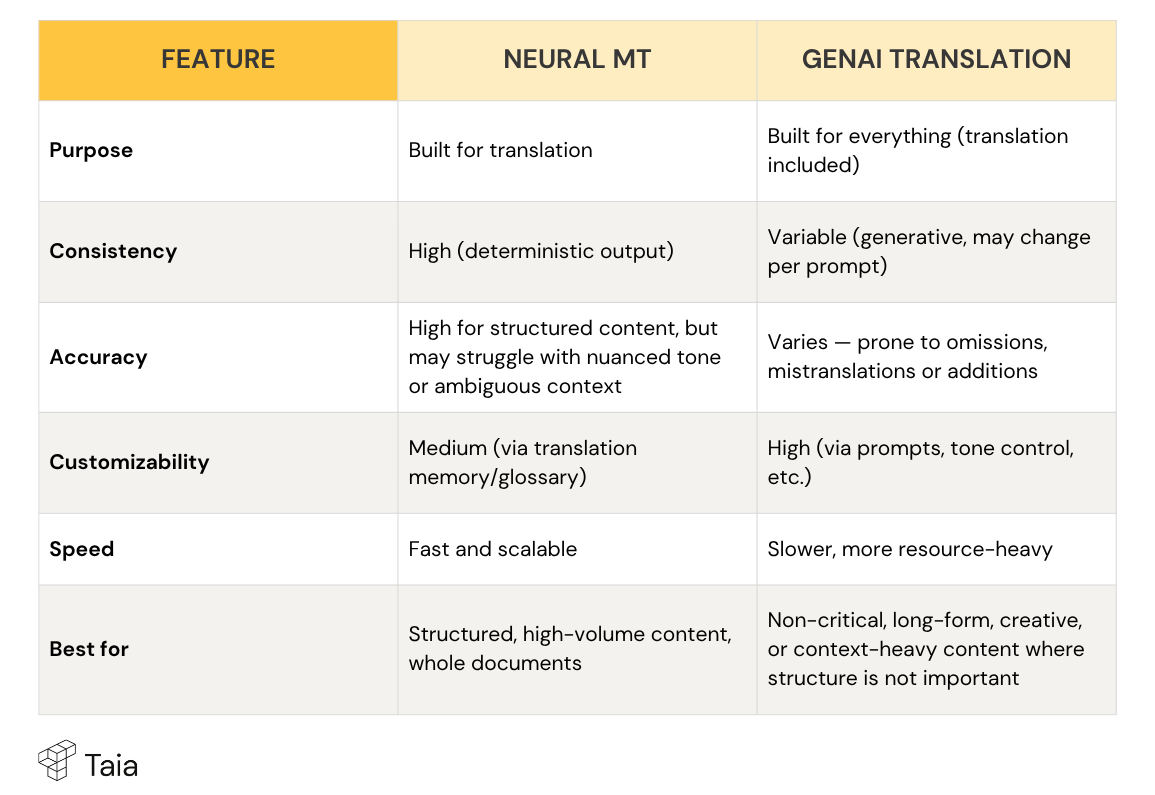
NMT vs GenAI translation feature comparison
Where LLM-based AI translation can fall short
Despite its fluency, LLM-based translation comes with risks:
- It might omit details or invent things (“hallucinations”) – see our full analysis
- Terminology can be inconsistent without a glossary
- It can’t process nor translate whole documents
- It can’t process large amounts of data at once (making it better to translate section by section)
- It’s harder to control across multiple users or large projects
- It can be significantly slower and more expensive than NMT
Common myths about AI and machine translation - debunked
Translation tech has come a long way – but the internet still clings to some outdated (or just plain wrong) ideas. Let’s clear a few of them up.
Myth 1: “AI translation is just a fancy word for neural machine translation.”
Not quite. Neural MT is a type of AI, yes – but AI translation often refers to generative AI translation – large language models (LLMs) like ChatGPT, Gemini, or Claude, which weren’t trained to translate, specifically.
NMT is task-specific. Generative AI translation is general-purpose. Big difference in how they behave and how much you can trust them.
Reality: Neural MT is built for consistency and speed. GenAI translation is built for flexibility and fluency – but it can go rogue without supervision.
Myth 2: “Machine translation is outdated.”
It depends what you mean. If you’re thinking of the clunky, word-by-word systems from the ’90s? Yes, those should stay there. But modern machine translation includes neural MT and AI translation, and it’s powering billions of words a day behind the scenes.
Reality: MT isn’t outdated – it’s evolved and become the umbrella term for all computer-assisted translation.
Myth 3: “AI is so fluent, it doesn’t need human help.”
Fluent? Often. Accurate? Sometimes. Safe for legal disclaimers, privacy policies, or UX copy that defines your product? Not a chance – unless you have checks in place.
Reality: Even GPT-4 and Gemini can hallucinate, skip details, or get tone wildly wrong. That’s why hybrid AI + human translation is the smart approach for business-critical content.
Myth 4: “Once you pick a tool, you’re stuck with it.”
Not with smart platforms. You shouldn’t have to choose between speed and quality, AI and human, creativity and consistency.
Reality: With Taia, you can start with instant AI translation, then upgrade to self-service editor or full human review – all in one place, on demand.
Machine translation examples: GenAI translation vs. NMT in action
Let’s put theory to the test. To really see the difference between GenAI translation and neural MT (we will skip old-school machine translation), let’s run a simple example and evaluate how each type performs.
Example: A customer service message
Original (English):
“We dropped the ball by sending the wrong charger. Our team is doing everything to make it right.”
Neural MT (DeepL, Google Translate…):
“Nous avons fait une erreur en envoyant le mauvais chargeur…”
Clear and accurate. Lacks idiom, but avoids confusion.
GenAI translation (ChatGPT, Gemini, Claude…):
“On s’est trompés avec le chargeur – désolés ! On s’en occupe.”
Casual and natural – but borderline too informal for some contexts. Risky if tone control matters. Customizable via prompts.
With Taia, you can combine neural precision with a style guide and glossary – and still bring in human oversight for tone-sensitive content like this.
When to use AI translation vs. NMT? A quick decision guide
Still wondering whether you should trust AI, stick with neural MT, or go full human?
Here’s your cheat sheet. Think of translation like content triage: not all content needs the same level of precision.
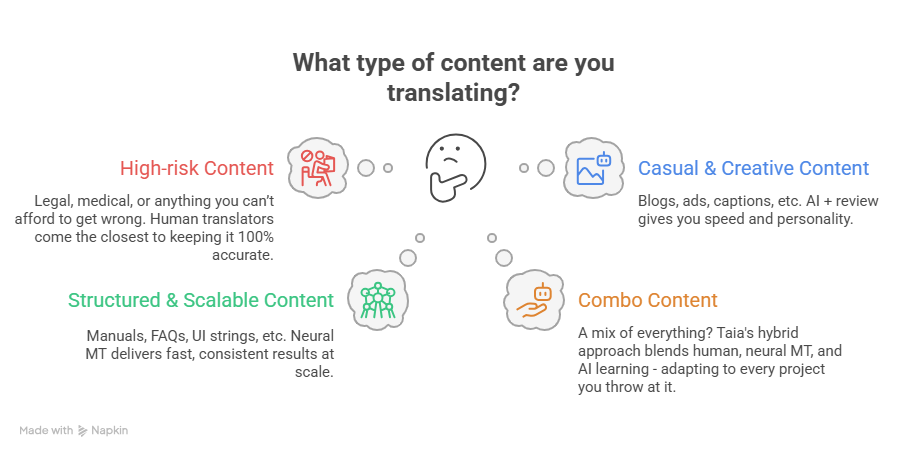
What type of content are you translating? Use this guide to choose the right approach.
Use Taia’s hybrid AI translation when you want:
- Blazing-fast turnaround
- Style and tone flexibility
- Built-in support for glossaries, translation memory, and 65+ file types
- An instant upgrade path to human revision
- Team and project management options
This covers most real-world needs: support docs, long-form content, product descriptions, internal comms – fast, fluent, and brand-aware.
Use GenAI translation (LLMs like ChatGPT) when:
- You’re translating casual, non-critical content
- You need to adapt tone or rewrite in a specific voice
- You have resources for reviewing and tweaking the output manually
- You’re not translating high-risk content (think: nothing legal or medical)
Remember: AI translation alone ≠ safe for mission-critical use. Use with care. Read more about the truth about AI translation services.
Use neural MT (like Taia, DeepL, or Google Translate) when:
- You need speed and consistency for high-volume content
- Your content is repetitive, structured, or context-light (think: UI strings, FAQs, legal disclaimers)
- You want to reuse past translations through a translation memory software
- You need a deterministic system (same input = same output)
- You want a scalable solution
💡 But here’s the catch: tools like DeepL and Google Translate are general-purpose engines – you get what everyone else gets. No memory of your brand, no real glossary support, no control.
Taia, on the other hand, is tailored to your content. It learns from your translation memory, respects your terminology, and scales across your entire workflow – all while keeping costs low and output as high-quality as possible.
And when AI isn’t enough? One click gets you an instant quote and a human-in-the-loop.
Taia is built for teams who care about translation quality and control.
Use human translation when:
- Accuracy and nuance are non-negotiable
- You’re working with legal contracts, technical manuals, or cultural content
- You want full control over tone, style, and terminology
- You’re launching in a new market and need native insight
Even the smartest AI can’t beat a seasoned human when it comes to context, emotion, and meaning. That’s why Taia’s professional localization services combine AI speed with human expertise.
Tools & platforms using each type - and how they stack up


Translation tools comparison: AI translation vs machine translation vs NMT platforms
Why Taia stands out
Most tools on this list are either:
- A translator or a TMS (translation management system)
- Built for strings or documents
- Either cheap and risky, or pricey and robust
Taia combines all of the above in one workflow:
You get document-level AI translation, customizable neural MT, translation memory + glossary, and the ability to upgrade to human review when needed – without switching tools.
You can also create teams, assign roles, billing, and track your projects, making it a perfect tool for in-house localization teams and ecommerce businesses.
Whether you’re translating 3 product pages or 3,000 user manuals, Taia adapts to your content, your tone, and your deadlines.
It’s a smart, flexible system that:
- Handles AI, NMT, and human translation in one place
- Adapts to your tone, glossary, and domain
- Supports entire files (65 file types), not just strings or copy-paste
- Gives you the power to scale – without sacrificing quality
- Provides organization and tracking for your whole process
Whether you’re a marketing manager juggling 10 product pages, a developer localizing a new feature, or a legal team translating a contract – Taia gives you a translation workflow that’s fast, smart, and built for real life.
Translate your first document for free >>
Frequently asked questions
What is the difference between AI translation and machine translation?
Machine translation (MT) is the umbrella term for all computer-assisted translation – including rule-based, statistical, and neural systems. AI translation specifically refers to modern systems powered by neural networks (neural MT) or large language models (GenAI translation like ChatGPT). All AI translation is machine translation, but not all machine translation is AI-powered.
Is neural machine translation the same as AI?
Yes, neural machine translation (NMT) is a form of AI translation. NMT uses deep learning neural networks to translate text. However, when people say “AI translation” today, they often mean generative AI tools (LLMs) like ChatGPT, which go beyond traditional NMT by offering tone adaptation, summarization, and creative rewriting – though with less consistency and more risk of hallucinations.
Which is more accurate: AI translation or neural machine translation?
Neural MT (like Taia, DeepL, or Google Translate) is generally more accurate for structured, high-volume content because it’s deterministic and trained specifically for translation. GenAI translation (ChatGPT, Gemini) can be more fluent and natural-sounding but is prone to hallucinations, omissions, and inconsistent terminology. For mission-critical content, neural MT with human review is the safest bet.
Can I use AI translation for legal or technical documents?
Not without human review. While AI translation (both neural MT and GenAI) has improved dramatically, legal and technical documents require 100% accuracy, consistent terminology, and precise phrasing. A mistranslation in a contract or manual can have serious consequences. Use professional human translation or a hybrid approach with AI + human post-editing for these use cases.
What kind of AI does Taia use?
Taia uses advanced neural machine translation (NMT) powered by deep learning models. Our AI is trained specifically for translation and works in tandem with your translation memory, glossary, and optional human revision. Unlike general-purpose LLMs (ChatGPT, etc.), Taia’s NMT is fast, consistent, secure, and doesn’t hallucinate. LLM integration is on our roadmap for optional content enhancement.
Can I combine AI translation with translation memory and glossary terms?
Yes! This is where Taia shines. Our platform combines neural MT with your translation memory (reusing past translations) and custom glossaries (enforcing your brand terminology). This ensures consistency across projects while maintaining AI speed. Most standalone AI tools like ChatGPT don’t support TM or glossaries natively.
What are some examples of automated translation services?
Automated translation services include:
- Neural MT tools: Taia, DeepL, Google Translate, Microsoft Translator, Amazon Translate
- GenAI translation: ChatGPT, Gemini, Claude (with translation prompts)
- TMS with MT: Taia’s TMS, Lokalise, Smartling, Phrase, Crowdin
- LSP MT services: Most language service providers now offer machine translation + post-editing (MTPE)
Are machine translation services free?
Some are, with limitations:
- Google Translate: Free for browser/app use; paid API for commercial use – see our comparison
- Microsoft Translator: 2M free characters/month via Azure, then paid
- DeepL: Free tier (500 characters at a time), paid plans start at $8.74/month
- ChatGPT: Free tier available, but limited; paid plans for higher volume
- Taia: First document free, then pay-per-use or subscription plans
How accurate is AI translation? (aka: how good is AI translation?)
AI translation accuracy varies by:
- Language pair: High-resource pairs (English-Spanish, English-German) perform better than low-resource pairs (English-Icelandic)
- Content type: Structured content (UI strings, FAQs) works well; creative, cultural, or idiomatic content needs human help
- Tool quality: Neural MT tools like Taia and DeepL are more accurate than older SMT systems
- Context: AI struggles with ambiguity, cultural nuances, and brand voice without guidance
Bottom line: AI translation is good enough for 70-90% of content when combined with translation memory and glossaries. For mission-critical content, add human review. Read more about the truth about AI translation.
How does machine translation work?
Machine translation works by analyzing patterns in bilingual text data to learn how to convert text from one language to another. Modern systems use:
- Neural networks (NMT): Deep learning models that encode entire sentences, understand context, and generate fluent translations
- Transformer architecture: The same tech behind ChatGPT, optimized for handling word dependencies and reordering
- Training data: Millions of sentence pairs in multiple languages (Taia supports 189 languages)
- Continuous learning: Systems improve by learning from user corrections, translation memory, and glossaries
Taia’s AI translator uses this approach but adds document-level context, your custom terminology, and optional human refinement for maximum accuracy. Plus, we support 65+ file formats including Word, PDF, Excel, and more.
Ready to experience the difference? Try Taia’s AI translation for free and see how neural MT + translation memory + human expertise work together.

Project Manager & Content Writer
Eva is a project manager and occasional content writer who has honed her skills in marketing localization since 2019. Like most millennials, she's a Potterhead. She loves traveling and collecting bookmarks, used books, and vinyl.