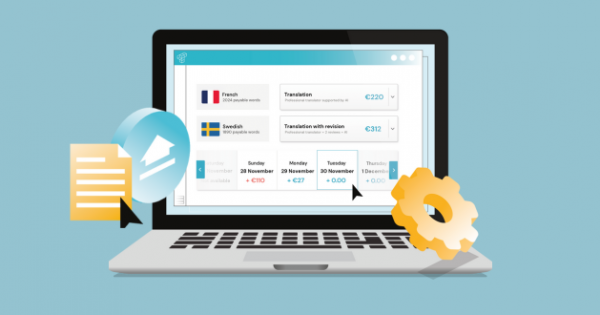
At Taia, we understand that each client has unique translation requirements and budget constraints. That’s why we’ve designed our platform to provide a range of translation services tailored to your specific needs. With a simple and user-friendly interface, Taia empowers you to select the translation service that best suits your project and budget.
In this article, we’ll explore our four main translation quality tiers in detail:
- Automatic - AI-only Machine Translation (MT)
- Essential - Basic Translation (MT + 1 linguist)
- Enhanced - Translation with Revision (MT + translator + revisor)
- Ultimate - Translation with Revision and Proofreading / TEP (MT + translator + revisor + proofreader)
By the end, you’ll know exactly which tier fits your content type, quality needs, and budget.
Automatic - Machine Translation (MT)
What is it?
Pure AI-powered translation with no human involvement. Your files are translated in seconds using enterprise-grade AI models (the same technology powering tools like DeepL and Google Translate, but integrated into Taia’s workflow platform).
When to use it:
✅ Internal communications - Emails, memos, Slack messages you just need to understand
✅ Quick gist translations - Understanding the general meaning of foreign-language documents
✅ High-volume, low-stakes content - Social media comments, customer feedback for analysis
✅ Budget-conscious projects - Maximum speed, minimum cost
When NOT to use it:
❌ Important documents - Legal contracts, regulatory filings, compliance documents
❌ Marketing and advertising - Brand messaging, website copy, campaigns (tone and nuance critical)
❌ User manuals and instructions - Risk of misunderstanding could cause harm or damage
❌ Customer-facing content - Anything representing your brand to external audiences
Why? Machine translation is fast and affordable but lacks human judgment for context, tone, cultural nuance, and brand voice. It’s perfect for understanding content but risky for representing your brand or critical accuracy needs.
What you get:
- Translation speed: Seconds to minutes (even large files)
- Cost: Lowest tier (typically $0.01-0.03 per word)
- Quality: 70-85% accuracy (varies by language pair and content complexity)
- Use case: Internal understanding, not external publication
Machine translation is mostly used for quick translations of content meant for internal use (such as in-house emails, understanding foreign vendor communications, analyzing customer feedback).
Essential - Basic Translation (MT + 1 Linguist)
What is it?
Machine translation + professional editing. Your content is first pre-translated by AI (fast and cost-effective), then a single professional linguist reviews and edits the translation to ensure meaning is accurate and language is correct.
Focus: Accuracy of meaning (not style or tone refinement).
When to use it:
✅ Internal business documents - SOPs, internal guidelines, employee handbooks, policies
✅ Contracts and legal agreements - Where meaning is clear and cannot be easily misconstrued
✅ Technical documentation for internal teams - Engineering specs, product requirements (internal stakeholders)
✅ Budget-conscious professional translation - Need human quality assurance but cost is a major factor
When NOT to use it:
❌ Customer-facing marketing content - Brand voice and tone matter (this tier focuses on meaning, not style)
❌ User manuals for end customers - Risk of confusion if language is awkward (even if technically correct)
❌ Legal documents with ambiguity - Complex legal language benefits from multiple linguist reviews
Why? Basic Translation gives you professional accuracy at a lower price point than higher tiers. One linguist ensures the translation is correct (meaning preserved, grammar accurate), but may not sound perfectly natural to a native speaker.
Perfect for: Companies wanting to keep costs low while ensuring professional oversight (combination of AI efficiency + human quality control).
What you get:
- Translation speed: 1-3 days (depending on word count)
- Cost: Mid-low tier (typically $0.05-0.08 per word)
- Quality: 85-90% accuracy, meaning correct, may have minor awkwardness in phrasing
- Process: AI pre-translation → 1 professional linguist edits and validates
- Use case: Internal documents, contracts, technical docs for internal use
Basic Translation is perfect for documents you need translated for your own use, to be shared with employees or close associates. It is particularly suited to day-to-day business documents such as internal guidelines (SOPs, ROPs, memos) and regulations, as well as contracts and other legal agreements where the meaning cannot be easily misconstrued.
However, be careful with using this service for customer-facing content (websites, marketing materials, user manuals for end customers).
Conclusion:
If you’re just looking for a quick professional translation that will help your reader understand the content in their language, and you’re not worried about some minor awkwardness, this may be the best option for you.
Besides the cheaper price tag, fewer checks mean faster delivery time—perfect for when you have high volume and tight deadlines.
If, on the other hand, you feel that Basic Translation may be too risky for your content type, you may wish to opt for a higher service tier. Check out our sections on Translation with Revision and Translation with Revision and Proofreading (TEP) below.
Enhanced - Translation with Revision (MT + Translator + Revisor)
What is it?
Taia’s standard professional service and the most popular tier in the translation industry. Your content goes through two professional linguists:
- Translator - Translates from scratch or edits AI pre-translation (depending on content)
- Revisor - Second linguist specialized in your topic reviews the translation, validates accuracy, and ensures nothing was overlooked
Focus: Accuracy + readability for broad audiences.
When to use it:
✅ Customer-facing websites - Product pages, about us, service descriptions
✅ Product descriptions and catalogs - E-commerce listings, brochures, spec sheets
✅ User manuals and instructions - End-user documentation (clarity critical)
✅ Press releases and announcements - External communications representing your brand
✅ Help center and knowledge base articles - Customer support content
✅ General marketing content - Blogs, newsletters, whitepapers
When NOT to use it:
❌ High-stakes marketing campaigns - Ad copy, landing pages where tone and persuasion are critical (use TEP instead)
❌ Creative content requiring cultural adaptation - Transcreation needs (slogans, taglines, emotional storytelling)
Why? Translation with Revision adds a second pair of eyes to focus on small details, ensuring accuracy and readability. Unlike internal documents (Basic Translation), customer-facing content must be clear, professional, and error-free on the first read.
If your customer doesn’t understand something, they’re unlikely to contact you to clarify—they’ll just leave. This is why two linguists are critical for customer-facing content.
What you get:
- Translation speed: 3-7 days (depending on word count and complexity)
- Cost: Mid-tier (typically $0.10-0.15 per word)
- Quality: 95-98% accuracy, professional and ready-to-publish
- Process: AI pre-translation → Professional translator → Specialist revisor validates
- Use case: Customer-facing content (websites, manuals, product descriptions, press releases)
What can I expect?
With Translation and Revision, you can expect a professional, ready-for-use translation with little to no errors. The only real difference between this tier and our top service (TEP) is that while the aim is accuracy, the focus here is not on style perfection.
For instance: There may be parts of the text which are translated correctly, but perhaps not exactly as a native speaker would naturally phrase it. If you don’t mind the reader deducing that the text has been translated, then Translation with Revision is likely the right choice.
Conclusion:
If your priority is precision and you don’t mind the reader potentially noticing the text was translated, then Translation with Revision sounds like it could be the right service for you.
Since this service is the standard in the translation industry, you can feel quite safe going with this option in most cases. But remember, if you’re still unsure which service to pick, you can always reach out to our sales team or dedicated Project Manager, who will be happy to advise you.
Ultimate - Translation with Revision and Proofreading (TEP)
What is it?
The highest quality service in the translation industry, commonly known as TEP (Translation, Editing, Proofreading). Your content goes through three professional linguists:
- Translator - Translates the content professionally
- Revisor - Specialist reviews for accuracy and terminology consistency
- Proofreader - Native speaker reads the final text to polish style, grammar, and flow—making it sound completely natural
Focus: Accuracy + native-level style and fluency.
When to use it:
✅ Marketing and advertising campaigns - Landing pages, ad copy, email campaigns
✅ E-commerce product pages - Where conversion rate depends on persuasive, natural language
✅ Brand messaging and taglines - Slogans, mission statements, brand manifestos
✅ High-value content marketing - Premium whitepapers, case studies, thought leadership
✅ Legal contracts for customers - Terms of service, privacy policies, SaaS agreements (customer-facing)
✅ Entering new markets - First impression content (websites, brochures, pitch decks)
When NOT to use it:
🟡 Internal documentation - Overkill for content that doesn’t need native fluency (use Basic or Enhanced instead)
🟡 High-volume, low-budget content - TEP is premium pricing (consider Enhanced for cost efficiency)
Why? TEP ensures your translation flows as if originally written in the target language—no trace of “foreignness.” This is critical for marketing and sales content where even subtle awkwardness can reduce trust and conversions.
Market research has unequivocally shown: Customers are much more inclined to buy from websites in their own language. But if your material does not sound natural, this could really detract from your localization strategy and damage the relationship between you and your customers.
For this reason, it’s important to have a proofreader read through your text to make sure it flows well for the native audience and sounds completely authentic.
What you get:
- Translation speed: 5-10 days (depending on word count and complexity)
- Cost: Premium tier (typically $0.15-0.25+ per word, depending on language and specialization)
- Quality: 98-100% accuracy, native fluency, indistinguishable from original content
- Process: AI pre-translation → Professional translator → Specialist revisor → Native proofreader polishes style
- Use case: Marketing, advertising, e-commerce, brand content, entering new markets
What can I expect?
With TEP, the aim is always to produce a text which flows in such a way that you would never doubt the originality of the text. At Taia, we use a combination of vendors we feel would be best suited to achieve this, delivering ready-to-go content that fits seamlessly into the target culture.
Conclusion:
If you’re entering foreign markets or thinking about doing so, it’s important to start off on the right foot. With marketing and advertising, just as visuals are key, so are the words you use.
Using our top tier service (TEP) will give you the assurance you need to get your brand’s message out there and reach new audiences or build a closer relationship with your existing customer base.
Invest in TEP when first impressions matter most.
How Quality Tiers Impact Price and Delivery Times
With each increase in quality tier, expect a corresponding rise in both price and delivery time. This is an investment in accuracy and peace of mind. For critical documents, a higher tier is often more cost-effective in the long run (avoiding misunderstandings, brand damage, or customer confusion).
Comparison table:
| Tier | Linguists Involved | Speed | Cost per Word | Best For |
|---|---|---|---|---|
| Automatic (MT) | 0 (AI only) | Seconds | $0.01-0.03 | Internal understanding |
| Essential (Basic) | 1 (Translator) | 1-3 days | $0.05-0.08 | Internal docs, contracts |
| Enhanced (Translation + Revision) | 2 (Translator + Revisor) | 3-7 days | $0.10-0.15 | Websites, manuals, product descriptions |
| Ultimate (TEP) | 3 (Translator + Revisor + Proofreader) | 5-10 days | $0.15-0.25+ | Marketing, advertising, brand content |
Note: Actual pricing varies by language pair (rare languages cost more), content complexity (legal/medical/technical may cost more), volume discounts, and your Translation Memory leverage (30-60% savings on recurring content).
Consistency Across Projects
One of the benefits of sticking to a particular quality tier across multiple projects is consistency. With our smart Translation Memory, the more you translate, the more you save on both time and money.
How it works:
- Every translation builds your Translation Memory (sentence-by-sentence database)
- Future translations automatically reuse previous segments (100% matches are free or deeply discounted)
- Terminology stays consistent across all content (product names, brand terms, technical jargon translated identically)
Example:
You translate your product website (10,000 words) with Translation + Revision. Three months later, you update the website (adding 2000 new words, 8000 words unchanged).
Cost savings: Only pay for the 2000 new words at full rate. The 8000 unchanged words are free or deeply discounted via Translation Memory.
With Taia’s Translation Memory, you don’t just translate—you build a strategic asset that makes every future translation faster, cheaper, and more consistent. Learn more about Translation Memory.
Your Dedicated Project Manager
When you start working with Taia, a dedicated Project Manager will be assigned to you (included free with company accounts), ensuring that all your projects meet the highest standards and consistency levels.
Your PM helps you:
- Choose the right quality tier for each content type (marketing → TEP, internal docs → Basic, etc.)
- Optimize costs by recommending when to use AI vs. Professional translation
- Maintain consistency across projects (same translators, shared Translation Memory, glossary management)
- Coordinate complex projects (multiple languages, tight deadlines, specialized content)
Understanding your needs is critical when selecting a translation quality tier. We’re always here to guide you in making the best choice for your project.
Ready to Put This Knowledge Into Action?
Choose Your Path:
Need fast, affordable translations?
→ Try Taia’s AI Translator for self-service translation with built-in editing tools.
Need professional human translation?
→ Explore Professional Translation Services and select your quality tier.
Not sure which tier fits your content?
→ Book a demo with our team to explore which quality tier suits your requirements.
Ready to start translating?
→ Sign up free and create your first project (2000-word free trial, no credit card required).
Frequently Asked Questions
How do I choose the right quality tier for my content?
Match quality tier to content purpose and audience: Use this decision framework: Who will read this translation? → Internal team only (employees, close partners): Essential (Basic Translation) or Automatic (MT) if just for understanding, External customers (website visitors, buyers, users): Enhanced (Translation + Revision) minimum, New market customers (first impression, high-value prospects): Ultimate (TEP) for native fluency. What’s the risk of errors or awkwardness? → Low risk (just need to understand general meaning): Automatic (MT), Medium risk (clarity important but not brand-critical): Essential (Basic) for internal, Enhanced (Translation + Revision) for external, High risk (brand reputation, conversions, legal accuracy): Ultimate (TEP). What’s the content type? → Internal communications (emails, memos, Slack): Automatic (MT) → Internal documents (SOPs, policies, internal reports): Essential (Basic Translation) → Contracts and legal agreements (internal or straightforward): Essential (Basic) or Enhanced (Translation + Revision) if complex → Product documentation (user manuals, help articles): Enhanced (Translation + Revision) → Website content (product pages, service descriptions): Enhanced (Translation + Revision) → Marketing and advertising (campaigns, landing pages, ad copy): Ultimate (TEP) → E-commerce product listings (conversion-critical): Ultimate (TEP) → Brand messaging (mission statements, taglines, slogans): Ultimate (TEP) or transcreation. What’s your budget? → Tight budget: Start with Automatic (MT) for understanding, upgrade to Essential (Basic) for professional oversight → Moderate budget: Use Enhanced (Translation + Revision) for most customer-facing content → Premium budget / entering new markets: Invest in Ultimate (TEP) for critical content (websites, marketing, first-impression materials). Real-world examples: Example 1: SaaS company → Internal product specs (engineering team): Essential (Basic) → $0.05/word → Help center articles (customer support): Enhanced (Translation + Revision) → $0.12/word → Marketing website homepage (first impression for new market): Ultimate (TEP) → $0.20/word → Result: Optimized cost ($0.05/word for internal, $0.20/word for conversion-critical), right quality for each audience. Example 2: E-commerce brand → Internal vendor contracts (terms with suppliers): Essential (Basic) → $0.06/word → Product descriptions (short, conversion-critical): Ultimate (TEP) → $0.18/word → Customer service emails (templates for support team): Enhanced (Translation + Revision) → $0.11/word → Result: Premium quality where it drives revenue (product pages), cost savings where lower risk (internal docs). Example 3: Legal firm → Understanding foreign legal documents (opposing counsel, discovery): Automatic (MT) → $0.02/word → Client-facing contracts (SaaS agreements, T&Cs): Enhanced (Translation + Revision) → $0.14/word → High-stakes litigation documents (court filings, depositions): Ultimate (TEP) + legal specialist → $0.30/word → Result: Cost savings on high-volume understanding (MT), accuracy on client-facing (Enhanced), perfection on critical legal work (TEP). When to upgrade tier: Start with lower tier (Basic or Enhanced) for initial translation, If awkwardness or errors found, upgrade to higher tier for future content, Over time, most companies standardize: Internal = Basic, External = Enhanced, Marketing/Sales = TEP. When to downgrade tier: If content is low-stakes or just for internal understanding, downgrade to save cost, Use Translation Memory savings to offset cost of higher tiers on critical content. Still unsure? Ask your dedicated Project Manager (included free with company accounts), they’ll review your content and recommend optimal tier, Try multiple tiers: Order same content in Basic vs. Enhanced, compare quality and decide which meets your standards. With Taia’s flexible quality tiers, you can match quality and budget perfectly for every content type. Get started free and test different tiers risk-free!
What’s the difference between Translation with Revision and TEP (Translation, Editing, Proofreading)?
Both are professional human translation—key difference is the proofreading step for native fluency: Translation with Revision (Enhanced tier): 2 linguists involved: Translator: Professional linguist translates content (from scratch or editing AI pre-translation), focus on accuracy (meaning preserved, grammar correct, terminology consistent), Revisor: Specialist in your subject matter (legal, technical, medical, marketing, etc.) reviews translation, validates accuracy (catches errors, ensures nothing overlooked), ensures consistency (terminology, glossary compliance, tone), Result: Professional, accurate translation ready for publication, minor awkwardness may remain (technically correct but may not sound 100% native). Best for: Customer-facing content where clarity and accuracy are priority (websites, user manuals, product descriptions, help articles, press releases), content where reader understanding is critical (instructions, documentation, contracts), moderate budget (balance quality and cost). TEP - Translation with Revision and Proofreading (Ultimate tier): 3 linguists involved: Translator: Professional linguist translates content, Revisor: Specialist validates accuracy and consistency (same as Enhanced tier), Proofreader: Native speaker of target language reads final translation with fresh eyes, polishes style and flow (removes awkwardness, refines phrasing for natural sound), validates grammar and punctuation (fine-tuning), ensures cultural appropriateness (idioms, expressions sound natural to target audience), Result: Translation that reads as if originally written in target language (no trace of “foreignness”), native fluency and natural flow (sounds completely authentic), indistinguishable from content created by native copywriter. Best for: Marketing and advertising (campaigns, landing pages, ad copy, email marketing), e-commerce product pages (conversion depends on persuasive, natural language), brand messaging (mission statements, taglines, slogans), entering new markets (first impression content—websites, brochures, pitch decks), high-value content marketing (whitepapers, case studies, thought leadership). Side-by-side comparison: | Aspect | Translation with Revision (Enhanced) | TEP (Ultimate) | |--------|--------------------------------------|----------------| | Linguists | 2 (Translator + Revisor) | 3 (Translator + Revisor + Proofreader) | | Focus | Accuracy and clarity | Accuracy + native fluency | | Quality | 95-98% accurate, professional | 98-100% accurate, native-level style | | Natural flow | May sound slightly “translated” | Reads like original native content | | Speed | 3-7 days | 5-10 days | | Cost | $0.10-0.15/word | $0.15-0.25+/word | | Best for | Websites, manuals, product descriptions | Marketing, advertising, brand content | Real-world analogy: Translation with Revision is like a well-edited essay—correct, clear, professional, but you might notice it was translated. TEP is like a published article in The New York Times—flawless, natural, sounds like it was always in that language. When does the proofreading step matter most? High stakes: Marketing campaigns where conversions depend on persuasive language (awkward phrasing = lost sales), brand messaging representing company values (must sound authentic, not foreign). Cultural nuance: Content requiring idioms, humor, or emotional resonance (literal translation fails, native proofreader adapts culturally), taglines and slogans (must be punchy and memorable in target language). First impressions: Website homepage for new market launch (customers judge professionalism by language quality), investor pitch decks or sales presentations (credibility depends on polished language). When Translation with Revision is enough: Informational content (help articles, product specs, user manuals—clarity matters more than style), Large volume, moderate budget (e-commerce sites with thousands of product descriptions—Enhanced balances quality and cost), Technical or legal content where accuracy trumps style (contracts, compliance docs, engineering specs). Cost vs. value: Translation with Revision: Best ROI for most customer-facing content (95%+ quality at moderate cost), recommended for websites, documentation, general marketing. TEP: Premium investment for conversion-critical or brand-defining content, recommended for landing pages, ad campaigns, brand messaging, new market entry. Common strategy: Use Enhanced (Translation + Revision) for bulk content (product catalog, help center), upgrade to TEP (Ultimate) for high-value pages (homepage, key landing pages, flagship campaigns). Still deciding? Order same content in both tiers and compare (see the difference in natural flow firsthand), Ask your Project Manager for tier recommendation based on your content type and goals. With Taia’s professional translation services, you choose the quality tier that matches your content’s importance and budget. Start your first project and experience the difference!
Can I mix quality tiers across different content types?
Yes—and we highly recommend it for cost optimization: Smart tier mixing strategy: Tier selection by content type: Internal content (SOPs, internal memos, reports): Essential (Basic Translation) or Automatic (MT) → Lowest cost, sufficient quality for internal understanding. Customer support content (help articles, FAQs, knowledge base): Enhanced (Translation + Revision) → Clear, accurate, professional (customers need to understand easily). Product documentation (user manuals, technical specs): Enhanced (Translation + Revision) → Accuracy critical, style less important. General website content (about us, service pages, blog posts): Enhanced (Translation + Revision) → Professional quality, moderate cost. High-value marketing pages (homepage, key landing pages, pricing page): Ultimate (TEP) → Native fluency, maximum conversions. Ad campaigns and email marketing: Ultimate (TEP) → Persuasive language critical for ROI. Brand messaging (mission, vision, taglines): Ultimate (TEP) or transcreation → Must sound authentic and inspiring. Real-world examples: Example 1: SaaS company website → Homepage: TEP (Ultimate) - $0.20/word → First impression, conversion-critical → Pricing page: TEP (Ultimate) - $0.20/word → High-value, persuasion needed → Product feature pages: Translation + Revision (Enhanced) - $0.12/word → Informational, clarity key → Help center (50 articles): Translation + Revision (Enhanced) - $0.12/word → Customer-facing but informational → Internal product specs: Basic Translation (Essential) - $0.06/word → Internal team only → Result: Total cost: $4,200 (vs. $6,500 if all TEP) → Savings: $2,300 (35%) while maintaining quality where it matters. Example 2: E-commerce brand → Product descriptions (1000 SKUs): Translation + Revision (Enhanced) - $0.11/word → Conversion-important but too costly for TEP on 1000 products → Homepage and category pages: TEP (Ultimate) - $0.18/word → Brand impression critical → Customer service templates: Basic Translation (Essential) - $0.07/word → Support team uses internally (clarity over style) → Marketing emails (monthly campaigns): TEP (Ultimate) - $0.18/word → Drives revenue, persuasion key → Result: Optimized spending—TEP for revenue drivers, Enhanced for product catalog, Basic for internal. Example 3: Legal/Professional services firm → Client-facing website: TEP (Ultimate) - $0.22/word → Credibility and professionalism critical → Legal service descriptions: Translation + Revision (Enhanced) - $0.14/word → Accuracy key, legal tone expected → Internal case notes: Basic Translation (Essential) - $0.06/word → Lawyers just need to understand content → Understanding foreign documents (discovery): Machine Translation (Automatic) - $0.02/word → Just for gist, not publication → Result: Massive cost savings on high-volume discovery docs (MT), professional quality on client-facing (TEP). How to decide tier per content type: Ask: “What happens if this translation is awkward or has minor errors?” → Major problem (lost sale, damaged reputation, legal liability): TEP (Ultimate) → Moderate problem (customer confused, calls support): Enhanced (Translation + Revision) → Minor problem (internal team clarifies): Basic (Essential) → No problem (just for understanding): MT (Automatic) Benefits of mixing tiers: Cost optimization: Spend premium budget (TEP) only where it drives ROI (marketing, sales pages), save 40-60% by using Enhanced or Basic for less critical content. Quality where it matters: No compromise on conversion-critical pages (TEP for homepage, landing pages), professional quality for all customer-facing content (Enhanced for support, docs). Scalability: Translate high volumes affordably (use Basic/Enhanced for bulk content like help centers, product catalogs), invest in TEP for flagship content (homepage, key campaigns). How Taia makes tier mixing easy: Select tier per project - Each translation project can have different quality tier (create separate projects or specify per file), Dedicated Project Manager helps decide (PM reviews your content, recommends tier for each content type), Consistent Translation Memory across all tiers - Even if you use Basic for some content and TEP for others, all projects build shared Translation Memory, savings compound across all quality tiers. Example workflow: Step 1: Create project for website homepage → Select TEP (Ultimate) → Step 2: Create project for help center articles → Select Translation + Revision (Enhanced) → Step 3: Create project for internal SOPs → Select Basic Translation (Essential) → Result: Each project gets appropriate quality tier, all projects share Translation Memory (cost savings on all future projects). Common tier mixing patterns: B2B SaaS: TEP for website/marketing, Enhanced for docs/help center, Basic for internal → E-commerce: TEP for homepage/emails, Enhanced for products, Basic for internal support notes → Legal/Professional: TEP for client website, Enhanced for service descriptions, MT for understanding foreign docs → Healthcare/Medical: TEP for patient-facing materials, Enhanced for internal clinical docs, Basic for admin. Best practices: Document your tier strategy (e.g., “All marketing = TEP, all help content = Enhanced, all internal = Basic”), ensures consistency across projects, Review and adjust quarterly (if help center content converting well, maybe downgrade to Basic to save cost; if losing conversions, upgrade to TEP). With Taia’s flexible quality tiers, you can optimize every dollar while maintaining quality where it matters most. Start mixing tiers strategically today!
How does Translation Memory affect quality tier pricing?
Translation Memory can reduce costs by 30-60% across ALL quality tiers: How Translation Memory works with quality tiers: Translation Memory is tier-agnostic - Every translation (regardless of tier) builds your Translation Memory, Future projects reuse TM matches regardless of quality tier selected, Discount applies to all tiers (MT, Basic, Enhanced, TEP all benefit from TM savings). Pricing calculation: 100% matches (exact sentence previously translated): Free or 10-20% of tier rate → Example: TEP tier normally $0.20/word, 100% TM match = $0.02-0.04/word (90% savings). 75-99% fuzzy matches (similar sentence, minor edits needed): 30-60% discount off tier rate → Example: Enhanced tier normally $0.12/word, 85% fuzzy match = $0.05-0.08/word (40-50% savings). New segments (0-74% match): Full tier rate → Example: Basic tier $0.06/word, Enhanced $0.12/word, TEP $0.20/word. Real-world examples: Example 1: SaaS product website (TEP tier) → Initial translation (Version 1.0): 10,000 words → Tier: TEP (Ultimate) @ $0.20/word → Cost: $2,000 → Builds Translation Memory with 10,000 segments. Update (Version 1.1 - 3 months later): 11,000 words total (1000 new feature descriptions, 10,000 existing) → TM analysis: 10,000 words = 100% match (previously translated exactly), 1,000 words = new content (0% match) → Pricing: 10,000 words × $0.02 (100% match rate) = $200, 1,000 words × $0.20 (TEP full rate) = $200, Total: $400 (vs. $2,200 without TM) → Savings: $1,800 (82% reduction). Example 2: Monthly marketing emails (TEP tier) → Month 1: 800-word email campaign → TEP @ $0.18/word = $144 → Builds TM. Month 2: 850-word email (new topic, some similar phrases) → TM analysis: 300 words = 100% match (standard intro/CTA/footer), 200 words = 80% fuzzy match (similar product descriptions), 350 words = new content → Pricing: 300 × $0.02 = $6, 200 × $0.09 (50% discount) = $18, 350 × $0.18 = $63, Total: $87 (vs. $153 without TM) → Savings: $66 (43% reduction). Month 6: 800-word email → TM analysis: 500 words = 100% match (recurring CTAs, intros, standard phrases), 200 words = 85% fuzzy match, 100 words = new → Total: $28 (vs. $144 without TM) → Savings: $116 (81% reduction). Example 3: Help center articles (Enhanced tier) → Initial help center: 50 articles, 20,000 words → Enhanced @ $0.12/word = $2,400 → Builds help center TM. New articles (Month 6): 10 new articles, 4000 words → TM analysis: 1500 words = 100% match (standard UI instructions, navigation steps), 1000 words = 80% fuzzy match (similar troubleshooting steps), 1500 words = new content → Pricing: 1500 × $0.012 (100% match) = $18, 1000 × $0.06 (50% discount) = $60, 1500 × $0.12 (full rate) = $180, Total: $258 (vs. $480 without TM) → Savings: $222 (46% reduction). Translation Memory compounds over time: Months 1-3: Building TM → Savings: 10-20% (limited matches), Months 4-6: TM growing → Savings: 30-40% (common phrases recurring), Months 7-12: Mature TM → Savings: 50-60% on recurring content types (standard templates, repeated topics), Year 2+: Comprehensive TM → Savings: 60-80% on updates (most content already translated). Quality tier + TM strategy: High-volume recurring content (help centers, product docs, marketing emails): Invest in higher quality tier upfront (Enhanced or TEP), TM savings over time offset higher initial cost, Example: TEP costs $0.20/word initially, but after 6-12 months of TM buildup, effective cost drops to $0.08-0.10/word (cheaper than Basic tier without TM!). One-time or highly variable content (unique blog posts, custom projects): Consider lower tier (Basic or Enhanced) if TM leverage will be low, Less benefit from building TM if content never repeats. Cross-tier TM sharing: All tiers share same Translation Memory - Translate website with TEP (Ultimate) → builds TM, Translate help center with Enhanced → reuses TM from website (even though different tier), Result: TM savings apply regardless of tier selected per project. Maximizing TM savings: Consistency in source content: Use same terminology and phrasing in source language (before translation), template standard sections (introductions, CTAs, disclaimers), Upload existing translations: Already have translations from other tools? Import into Taia’s TM (TMX format supported), instant leverage from day one, Regular translation cadence: Translate weekly/monthly (builds TM faster) vs. sporadically (slower TM growth), Organize by content type: Separate TMs for different content (product docs vs. marketing vs. legal) if terminology differs significantly. Bottom line: Translation Memory makes higher quality tiers affordable over time. Invest in TEP (Ultimate) for critical content, leverage TM to reduce cost by 60-80% on updates and recurring projects. With Taia’s Translation Memory, your translation costs decrease over time while quality stays high. Start building your Translation Memory today!
What if I’m not sure which tier to choose for my project?
No problem—Taia’s dedicated Project Managers help you decide: How to get tier guidance: Option 1: Ask your dedicated Project Manager (company accounts) → All company accounts get assigned a free dedicated PM → PM reviews your content and recommends tier based on: Content type (marketing vs. documentation vs. internal), Audience (internal vs. customer-facing vs. new market), Budget constraints, Industry best practices (e.g., legal typically needs Enhanced or TEP, internal docs can be Basic). PM process: You describe your project (what content, who will read it, what’s the goal), PM asks clarifying questions (criticality, budget, timeline), PM recommends specific tier with rationale, You approve or discuss alternatives. Option 2: Book a demo with our team → Book a free demo (30-minute consultation), Our team reviews your content types and use cases, Provides tier recommendations and cost estimates, Shows platform demo tailored to your needs. Option 3: Start with a test project → Use free trial (2000 words, no credit card) to test a tier, Translate sample content in Enhanced (Translation + Revision), Review quality—if too basic, upgrade to TEP next time; if overkill, downgrade to Basic, Learn by doing (see firsthand what each tier delivers). Common scenarios and recommendations: “I’m launching a website in a new market” → PM recommendation: Homepage, key landing pages: TEP (Ultimate) - First impression critical, native fluency needed, General pages (about, services, blog): Enhanced (Translation + Revision) - Professional quality, moderate cost, Help center: Enhanced (Translation + Revision) - Clarity critical, style less important. “I need to translate product documentation” → PM recommendation: User-facing manuals (end customers): Enhanced (Translation + Revision) - Accuracy critical, minor awkwardness acceptable, Internal engineering specs: Basic (Essential) - Engineers just need to understand, API documentation (developer-facing): Enhanced (Translation + Revision) - Technical accuracy critical. “I have a marketing campaign with tight budget” → PM recommendation: Start with Enhanced (Translation + Revision) for initial campaign, Measure conversion rates in target language, If underperforming, test TEP (Ultimate) on key pages (homepage, landing page), Compare ROI: Does TEP’s higher cost generate enough additional conversions to justify upgrade? Data-driven decision (not guesswork). “I’m translating internal SOPs and policies” → PM recommendation: Basic (Essential) tier sufficient for internal documents, If legal/compliance-critical (e.g., HR policies, safety procedures), upgrade to Enhanced (Translation + Revision) for accuracy assurance. “I’m not sure if my content is ‘important enough’ for TEP” → PM asks: What’s the cost of a mistake or awkward phrasing? (Lost sale = $500 → invest $100 in TEP; just internal understanding = $0 risk → use Basic), What’s your target conversion rate? (If 2% conversion → improving language quality to 2.5% with TEP pays for itself), What’s your brand positioning? (Premium brand → TEP mandatory; budget brand → Enhanced acceptable). Decision framework PM uses: | Question | Basic | Enhanced | TEP | |----------|-------|----------|-----| | Who reads it? | Internal only | Customers (informational) | Customers (persuasive) | | Risk of awkwardness? | Low (team clarifies) | Medium (may confuse) | High (damages brand/conversions) | | Content type? | SOPs, internal docs | Websites, manuals, support | Marketing, ads, brand content | | Budget priority? | Minimize cost | Balance cost/quality | Maximize quality | What if you choose wrong tier initially? No problem—PM can adjust: Ordered Basic but quality insufficient? Upgrade to Enhanced or TEP (pay difference), Ordered TEP but overkill for your needs? Switch to Enhanced for future projects (save cost), PM learns your preferences over time (recommends optimal tier automatically). Success story: Customer initially ordered Basic for e-commerce product descriptions (budget-conscious), Conversion rates in new market lower than expected, PM recommended TEP test on top 50 products (highest traffic), Result: Conversion rates increased 18% on TEP-translated products, ROI positive → customer switched all product descriptions to TEP, TM savings over 6 months made TEP affordable (effective cost dropped to $0.12/word from $0.18/word initial). Bottom line: You’re never locked into wrong tier—PM helps you choose, test, and adjust based on results. With Taia’s dedicated Project Manager support, you always get expert guidance on tier selection. Get started and connect with your PM today!

Localization Experts
The Taia team consists of localization experts, project managers, and technology specialists dedicated to helping businesses communicate effectively across 189 languages.