When we started Taia, our idea was simple: clients would provide everything needed for their localization project.
They’d send files, tell us why they needed them translated, and what mattered to them. We’d then offer a quick quote – no excessive back-and-forth.
Initially, we assumed clients had a localization project management strategy. We quickly learned that wasn’t always the case. Many lacked clear processes, often sending messy files or missing key resources.
Over time, we found ourselves taking on a consultative role, with translation and localization becoming just one piece of the puzzle.
Today, we localize content for companies by helping them with everything from API integrations to terminology analysis, with a vision to turn our AI-driven localization into a seamless process.
So, what steps ensure a smooth localization project management process? Let’s dive in – and stick around for the bonus tip!
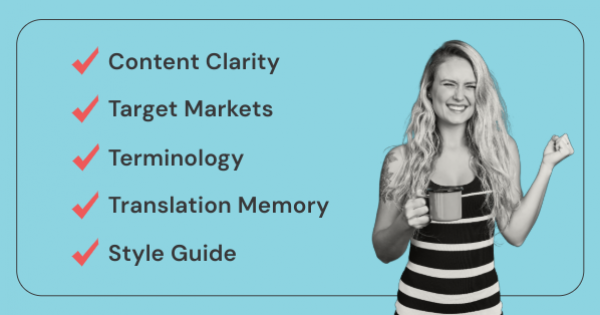
Step 1: The Staples of Good Localization Project Management
Content and files.
Or, as I like to call it, “Rubbish In, Rubbish Out.”
Quality starts with the source. We often receive files so messy even their creators wouldn’t recognize them. If the original content isn’t clear, a professional translator cannot fix that, no matter how capable they might be.
The Content: Start Strong
A well-written document will always lead to a successful document translation, and a badly written one won’t. It’s really as simple as that.
Sometimes we get beautifully crafted pieces; other times, we receive incomprehensible documents – think user manuals written in “Chinglish” after a rushed Google Translate or DeepL job. Remember: Rubbish in, rubbish out.
Ensure your content follows clear standards and undergoes a secondary revision. If needed, we can assist with content creation and proofreading as part of the localization project management process.
The Files: Format Matters
Content usually lives in a CMS or software database and needs exporting before it reaches our localization software. We support over 65 file types and can return formatted files intact 99% of the time.
But here’s a rule of thumb: if it’s hard for you to edit, it’s hard for us too. And yes, we’re talking about PDFs.
PDFs are great for finalized documents but tricky for document translation. Whenever possible, provide the original source file – whether Word, Google Docs, InDesign, or another format.
Web content? Exporting from your CMS in XML, JSON, or XLF is best. We can handle HTML, but CMS exports streamline re-importing translations.
Summary: Ensure content is well-written and in an editable format for a smoother localization project management. Check out our list of supported file types.
Get an instant quote for your project
No credit card or verification needed.
Step 2: What Are Your Target Markets?
“We need translations from English to Spanish and English to French, please.”
Sure, we can do that. But I can see that you are a company from the US. Are you expanding into the EU markets? Or are you going to work with Canadian and Latin American markets?
Many clients don’t realize the differences between regional variations of languages. As a European, I’d assume you want France French and not Canadian French, but assuming makes an “ass” out of “u” and “me.”
Understanding your goals helps us guide you through our localization project management process. So, please endure our curiosity when we start working together – we ask a lot of questions!
Summary: Define your target markets – not just languages – before starting. It makes localization management more effective and ensures you reach the right audience.
Step 3: Terminology Matters
We often find ourselves collaborating with clients from very technical fields, translating their technical documentation, be it hardware or software. Now, if what a super ionized flux capacitor does is very straightforward to you, it’s probably not so obvious to the rest of us. Most translators geek out on other stuff.
As much as we try to always find the best professional translators and linguists who are experienced in your industry, they’re still not experts like you and your team.
When dealing with complex content, we recommend building a glossary. A glossary is a list of words and phrases that are common in your content. We equip this glossary with short descriptions and explanations, as well as the expected translations into the target languages and locales we’re working with.
Every now and then, a magical client comes up and tells us they already have an extensive list of terminology for us. That’s when we pop a bottle of the finest wine. But if not, we:
- Ask for any reference material you can share.
- Use AI to scan your content, extract key terms, and identify patterns.
- Have linguists refine the list and propose translations.
- Let you approve and add descriptions.
Our AI checks terminology before human translators even start, and the system flags inconsistencies. Pretty nifty, right?
Summary: Terminology lists (glossaries) ensure accuracy and consistency in professional translation. If you don’t have one, we’ll help create it.
Step 4: Translation Memory (TM) - Your Translation Vault
Any professional translation agency will use Translation Memory (TM) to store previously translated content, ensuring consistency, efficiency, and cost savings.
A TM is a database that stores all of your previously translated segments (sentences, phrases, or words), paired with their target translations. Every time you submit new content, the system cross-references it with your TM and automatically applies any matches from the database. This not only speeds up the localization process but also ensures that your translations remain consistent across different projects.
If you’ve worked with another professional translation company, you likely have a TM – though some providers keep it under wraps. But here’s the thing: your TM is your property. Ask your LSP to export it in TMX format, and we can use it to improve future translations.
If you don’t have one, we can build it by analyzing previous translations. A well-maintained TM boosts quality while reducing costs.
Summary: A Translation Memory saves time and money while ensuring high-quality translations. Always request yours from your previous provider!
Step 5: A Style Guide or How to Keep Your Brand Voice Across Languages
A glossary ensures correct terminology, while a style guide ensures the right tone and voice for your brand.
Some companies prefer formal communication; others want a casual, friendly style. Preferences on British vs. American English, date formats, and punctuation all play a role.
A style guide covers:
- Tone of voice: Professional, friendly, technical, humorous?
- Formatting: How should dates, numbers, and currencies appear?
- Capitalization & punctuation: Any specific rules?
- Cultural nuances: How should cultural references be adapted?
- Formal vs. Informal address: For example, German uses “du” vs. “Sie” – which fits your audience?
With a style guide, multiple professional translators can work on your content while maintaining a consistent brand voice. This is key when we localize content for multiple regions and languages.
Summary: A style guide ensures consistency across all of your translated texts, keeping your brand voice intact.
Bonus Tip: Selecting the Right Quality for the Right Content
Not all content needs the same level of localization management. We offer everything from AI-only, fast document translation services to full Translation, Editing, and Proofreading (TEP).
Marketing materials and customer-facing content should be fully localized. But for internal documents, product updates, or short-lived content, AI-assisted document translation is a cost-effective alternative.
Choosing the right quality level ensures the best return on your translation and localization investment.
Final Thoughts
Localization management is more than just translating a few documents – it’s creating a seamless experience for you, for professional translators, and most importantly, for your audience. Following these five steps (plus our bonus tip) ensures quality, efficiency, and consistency.
Ready to elevate your localization project management? Reach out to us at Taia – we localize content with precision to help you make your global ambitions a reality.
Get an instant quote for your project
No credit card or verification needed.
Frequently Asked Questions
How does translation memory reduce localization costs?
Translation Memory (TM) stores all your previously translated content in a database. When you submit new projects, the system automatically identifies matching or similar segments and applies existing translations. This means you only pay for new or changed content – not for retranslating the same sentences multiple times. Over time, a well-maintained TM can reduce translation costs by 20-40% while ensuring perfect consistency across all your content.
What file formats work best for localization?
The best file formats for localization are editable source files: Word (DOCX), Google Docs, InDesign (INDD), XML, JSON, or XLF exports from your CMS. We support over 65 file types, but avoid PDFs whenever possible – they’re difficult to edit and extract text from. If you work with web content, CMS integrations or API connections streamline the entire localization workflow by eliminating manual file handling.
Why is a glossary important in professional translation services?
A glossary ensures that technical terms, product names, and brand-specific language are translated consistently across all content and languages. Without one, different translators might use different terms for the same concept, creating confusion for your customers. Our AI-powered system checks terminology before human translators start work and flags any inconsistencies, ensuring that your “flux capacitor” is always a “flux capacitor” – never a “flow condenser.”
What are common mistakes companies make when localizing content?
The most common localization mistakes include: (1) Sending poorly written source content and expecting translators to fix it, (2) Not specifying regional language variants (Spanish for Spain vs. Latin America), (3) Providing PDFs instead of editable source files, (4) Skipping terminology management and style guides, (5) Treating all content equally instead of using tiered quality levels for different content types. Following our 5-step localization project management framework helps avoid these costly errors.
How can I make sure my brand voice stays consistent across languages?
Maintain consistency by creating a comprehensive style guide that documents your brand’s tone, formatting preferences, and cultural adaptation rules. Combine this with a glossary for terminology and a Translation Memory for previously translated content. Work with a translation management system that enforces these assets automatically. At Taia, our AI checks style and terminology compliance before human linguists review the content, ensuring your brand voice remains consistent across all 189 languages.
What’s the difference between localization and translation in project management?
Translation converts text from one language to another. Localization adapts your entire user experience for a specific market – including translation, cultural adaptation, formatting (dates, currencies, units), visual elements, and market-specific messaging. Localization project management orchestrates all these elements, ensuring that files, terminology, translation memory, style guides, and quality levels work together seamlessly. It’s not just about words – it’s about creating an authentic experience for each target market.
How do I choose between AI translation and human translation?
Use AI translation for high-volume, time-sensitive, or internal content where perfect accuracy isn’t critical (product catalogs, support tickets, internal docs). Use human translation for customer-facing content that drives conversions: marketing materials, UI/UX, legal documents, and high-value product descriptions. The smartest approach is hybrid: AI for speed and scale, human review for quality and brand voice. Our Translation Management System lets you mix both approaches based on content priority.
Can I use translation memory from my previous translation provider?
Absolutely! Your Translation Memory is YOUR asset, not your translation provider’s. Any professional LSP should provide your TM in standard TMX format upon request. If they refuse or claim it’s proprietary, that’s a red flag. At Taia, we can import your existing TM and use it immediately to ensure consistency and reduce costs. If you don’t have one, we’ll build it from your previous translations, giving you a valuable asset for future localization projects.
How do regional language variants affect localization project management?
Regional variants (like European Spanish vs. Latin American Spanish, or UK English vs. US English) have different vocabulary, spelling, grammar, and cultural references. Failing to specify your target region leads to mismatched content that feels foreign to your audience. In localization project management, defining exact regional variants helps us: (1) Assign translators native to that region, (2) Apply region-specific style guides, (3) Use appropriate Translation Memory matches, (4) Adapt cultural references correctly. Always specify your exact target markets, not just languages.

Project Manager & Content Writer
Eva is a project manager and occasional content writer who has honed her skills in marketing localization since 2019. Like most millennials, she's a Potterhead. She loves traveling and collecting bookmarks, used books, and vinyl.