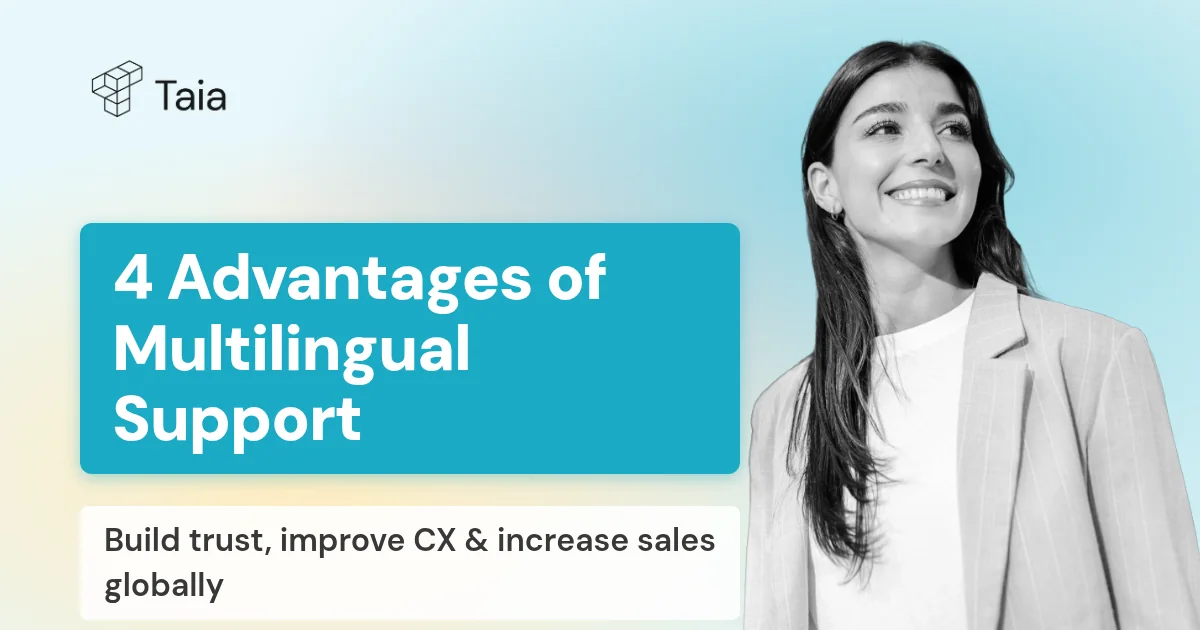
70% of buying experiences are based on how the customer feels they are being treated, showing that customer support has become an integral part of business success. To really connect with your customers, it’s important to speak their language.
That’s when multilingual customer support comes into play. But what exactly are the advantages of adapting your language to your target audience?
No. 1: Multilingual customer support builds trust and loyalty amongst customers
Around 72% of consumers claim they are more likely to buy from a website that provides information in their native language. That doesn’t apply to just website content, but also the customer support center.
When you communicate with your customers in their language, they will trust you more, which ultimately leads to brand loyalty. The dream of every company, right?
Professional localization services enable businesses to build authentic relationships with customers across language barriers, fostering the trust that drives long-term loyalty and repeat purchases.
No. 2: Improves the overall customer experience with your business
As already mentioned in the beginning, customer support has a big impact on how the consumer perceives the experience they have with your product/service. Even though English is one of the most spoken languages, we can’t ignore the fact that communicating with your customers in their language is going to make them feel more secure and understood.
When you’re offering help in your audience’s native language, it’s more likely that they will reach out to you as soon as any problems or questions arise. That way, you’ll be able to help your customer right away and provide quick solutions which will make their experience with your business worthwhile.
Modern AI-powered translation tools can help scale multilingual support efficiently, enabling businesses to respond quickly in multiple languages without massive overhead costs.
No. 3: Stand out amongst your competitors
Multilingual customer support doesn’t just build your brand’s image, it also gives you a bit of an advantage when it comes to acquiring new customers.
Intercom conducted a survey, from which they concluded that 35% of SaaS users are open to switching to a brand that offers information in their native language. Offering customer support in multiple languages gives you a bit of a competitive advantage, so there’s no need to dwell on it; make sure you offer support to your customers in their language!
For SaaS companies, multilingual support can be a decisive factor in winning competitive deals and reducing churn in international markets.
No. 4: Increased sales numbers
You’ve probably already caught the consumer’s attention when you offered them product/service information in their native language. Add multilingual customer support to that, and you’ll definitely improve your conversion rate!
Almost 74% of consumers prefer to buy again from companies that offer after-sales services (customer support) in their language. By speaking your customer’s language, you increase your chance of repeated sales.
Include multilingual customer support the easiest way possible!
It’s hard to find customer support agents that speak multiple languages, let alone those who speak it well enough to come off as a native. Sometimes it can get overwhelming, but there are tools that help you boost your efficiency when it comes to language localization.
A comprehensive translation management system streamlines the entire multilingual support workflow, ensuring consistent terminology across all customer touchpoints and enabling rapid translation of support documentation, FAQs, and customer communications.
By leveraging translation memory and terminology databases, businesses can maintain consistency in customer communications while significantly reducing translation costs and time.
Ready to transform your customer support experience? Contact us to learn how Taia can help you deliver exceptional multilingual customer support.
Frequently Asked Questions
How do you implement multilingual customer support without hiring native speakers for every language?
Implementing multilingual customer support doesn’t require hiring native-speaking agents for every target market—modern technology and strategic workflows enable cost-effective, scalable multilingual support even for small teams. Here’s a comprehensive roadmap for building multilingual support capacity:
1. Tiered Support Architecture
Most businesses benefit from a tiered approach that balances automation, translation technology, and human expertise:
Tier 1 - Automated Multilingual Chatbots (60-80% of inquiries): Modern AI chatbots can handle the majority of routine customer support questions in multiple languages simultaneously. Using natural language processing (NLP) and machine learning, chatbots can:
- Answer frequently asked questions in 50+ languages
- Guide customers through troubleshooting steps
- Process simple transactions (password resets, order tracking, basic account changes)
- Collect information before escalating to human agents
- Operate 24/7 without additional staffing costs
Platforms like Intercom, Zendesk, or Freshdesk offer multilingual chatbot capabilities that can be trained on your support documentation. You can create responses in your primary language and use AI translation to generate multilingual versions, then refine critical responses with professional review.
Cost impact: A multilingual chatbot implementation typically costs $100-$500/month for small businesses, $500-$2,000/month for mid-market companies, versus hiring native-speaking agents at $40,000-$80,000 annually per language.
Tier 2 - Translation-Assisted Human Agents (20-35% of inquiries): For more complex inquiries that require human judgment but don’t demand native fluency, train your existing support team to use real-time translation tools:
- Customer writes inquiry in their language → AI translates to support agent’s language → Agent crafts response in their language → AI translates response back to customer’s language
- Modern translation is accurate enough (85-95% for common languages) that this workflow handles most mid-complexity issues effectively
- Agents can spot obvious translation errors and rephrase for clarity
- Use translation memory to ensure consistent responses to common questions
Tools like Google Cloud Translation API, DeepL API, or integrated support platform translation enable this workflow within your existing ticketing system.
Cost impact: Minimal incremental cost beyond translation API fees ($5-$50/month per agent depending on volume) versus hiring additional multilingual staff.
Tier 3 - Native-Speaking Specialists (5-15% of inquiries): Reserve native-speaking agents or freelance translators for:
- High-value customers or enterprise accounts
- Complex technical issues requiring precise communication
- Sensitive situations (complaints, refunds, legal matters)
- Sales conversations where subtle cultural understanding matters
- Quality assurance and spot-checking of automated translations
You don’t need full-time native speakers for every language. Instead:
- Hire multilingual agents who cover multiple languages (one agent might speak English + Spanish + Portuguese)
- Use freelance support translators on-demand for specific languages during peak periods
- Partner with outsourced multilingual support providers for overflow or niche languages
- Schedule native-speaking agents during peak hours for their regions (don’t need 24/7 coverage for all languages)
Cost impact: Significantly lower than hiring full-time staff for every language. Freelance support translators typically charge $25-$50/hour with minimum commitments, versus $40,000-$80,000 annual salaries.
2. Comprehensive Knowledge Base Localization
Investing in multilingual self-service content dramatically reduces support ticket volume:
Content Prioritization: Start by translating your most-accessed support articles—typically 20% of articles answer 80% of questions. Use analytics to identify:
- Top 50-100 support articles by page views
- Most common ticket categories
- Seasonal or product-launch-specific content that needs urgent translation
- Getting started guides and troubleshooting documentation
Translation Strategy:
- Use AI translation for initial drafts of support documentation
- Have native speakers or professional translators review and refine critical articles (installation guides, account setup, billing/payment, legal/terms of service)
- Less critical content (minor feature explanations, tips and tricks) can use AI translation with light review
- Maintain terminology databases to ensure consistent product/feature names across all languages
Ongoing Maintenance:
- Establish workflows to translate new articles as they’re published (build translation into content creation process)
- Flag outdated translations when source content updates
- Use translation memory to minimize costs for recurring content
ROI: Companies typically see 25-40% reduction in support tickets after localizing knowledge bases, more than offsetting translation costs.
3. Template-Based Response System
Create a library of translated response templates for common support scenarios:
Template Categories:
- Account issues (password reset, login problems, email changes)
- Billing and payments (invoice requests, payment failures, refund procedures)
- Product functionality (feature explanations, integration setup, troubleshooting steps)
- Shipping and logistics (delivery times, tracking, returns)
- Technical issues (bug reports, system requirements, compatibility)
Implementation:
- Write comprehensive, clear templates in your primary language
- Get professional translation for all templates (one-time investment)
- Store templates in your support platform with tagging/categorization
- Train agents to select appropriate templates, customize with customer-specific details (names, order numbers, dates), and send
- Periodically review and update templates based on evolving products/policies
Benefits:
- Ensures consistent, high-quality communication in all languages
- Drastically reduces response time (agents don’t wait for translation)
- Lowers translation costs (translate once, use repeatedly)
- Maintains brand voice and terminology consistency
4. Strategic Language Selection
You don’t need to support every language immediately. Prioritize based on data:
Phase 1 - Foundation (2-4 languages): Support languages that represent 80%+ of your customer base or target markets. For most global SaaS companies, this might be:
- English (primary language)
- Spanish (Latin America + Spain, 580M+ speakers)
- German (Europe’s largest economy, strong B2B market)
- French (France, Africa, Canada)
Phase 2 - Expansion (3-5 additional languages): After establishing foundation languages and workflows, add:
- Portuguese (Brazil’s massive market)
- Japanese (high-value market with low English proficiency)
- Chinese Simplified (massive market, low English proficiency)
- Italian or Dutch (European expansion)
Phase 3 - Long-tail (10-20+ languages): Use automated translation with spot-checking for smaller markets:
- Eastern European languages (Polish, Czech, Romanian)
- Additional Asian languages (Korean, Thai, Vietnamese)
- Nordic languages (Swedish, Norwegian, Danish)
Start comprehensive (chatbot + knowledge base + templates) for Phase 1 languages, then add basic support (chatbot + key articles) for subsequent phases.
5. Practical Implementation Timeline
Month 1-2: Foundation
- Implement multilingual chatbot for top 3-5 languages
- Translate top 50 support articles
- Create translated response templates for 20 most common scenarios
- Train support team on translation-assisted tools
Month 3-4: Refinement
- Review chatbot performance and refine responses based on customer feedback
- Add translations for next 50-100 support articles
- Expand template library to 50-75 scenarios
- Hire or contract native-speaking agents for Tier 3 support in priority markets
Month 5-6: Expansion
- Add 2-3 additional languages based on customer demand
- Implement translation memory and terminology databases for consistency
- Establish ongoing translation workflows for new content
- Measure metrics (resolution time, CSAT scores, ticket volume by language)
6. Key Success Factors
Quality Assurance:
- Regularly review automated translations and refine problematic responses
- Monitor customer satisfaction scores by language to identify quality issues
- Have native speakers periodically audit chatbot conversations and agent responses
Cultural Adaptation:
- Different cultures have different communication expectations (direct vs. indirect, formal vs. informal)
- Train support teams on cultural norms for priority markets
- Adapt response tone and style by market (German customers often prefer formal communication; Americans prefer friendly informality)
Metrics and Optimization:
- Track resolution time by language
- Measure customer satisfaction (CSAT) scores by language
- Monitor ticket volume by language to identify resource needs
- Calculate cost per ticket by language to optimize approach
Technology Integration:
- Ensure translation tools integrate with your support platform (Zendesk, Intercom, Freshdesk, HubSpot Service Hub)
- Use APIs to automate translation workflows
- Implement translation management systems that connect support content with translation workflows
The Bottom Line:
You absolutely CAN deliver effective multilingual customer support without hiring native speakers for every language. The key is strategic use of technology (AI chatbots, translation APIs, knowledge bases), process optimization (templates, tiered support, prioritization), and selective use of native-speaking expertise for high-impact situations.
Most businesses can provide solid multilingual support in 5-10 languages for $2,000-$8,000/month (technology + translation + limited native-speaker support), versus $200,000-$400,000/year to hire full-time native-speaking agents for those languages. That 75-95% cost reduction enables even small businesses to compete globally through exceptional multilingual support.
What are the most common challenges in providing multilingual customer support and how do you overcome them?
Multilingual customer support presents unique operational, technical, and cultural challenges that can undermine customer satisfaction if not properly addressed. Understanding these challenges and implementing effective solutions is crucial for success.
Challenge #1: Inconsistent Terminology and Brand Voice Across Languages
The Problem: When multiple translators, support agents, or automated systems handle customer communications, product names, feature terminology, and brand voice often become inconsistent across languages. One agent might translate “subscription” as “suscripción” while another uses “abono” or “membresía” in Spanish. Your brand might sound professional and helpful in English but stiff and formal in German, or overly casual in Japanese where formal language is expected.
This inconsistency:
- Confuses customers who see different terminology in different touchpoints (website vs. support emails vs. knowledge base)
- Undermines brand professionalism
- Complicates customer communication when they reference features using terminology that support agents don’t recognize
- Creates trust issues when communication feels disjointed or “off”
The Solution:
Build Comprehensive Terminology Databases: Create and maintain glossaries for each language containing:
- Product names and feature names (official translations, never translate these differently)
- Technical terminology specific to your industry
- Company/brand-specific terms and phrases
- Common support phrases and expressions
- Terms that should NOT be translated (brand names, proprietary technologies)
Make these glossaries accessible to everyone involved in customer communication: support agents, translators, chatbot developers, content creators. Most modern translation management systems can enforce terminology automatically by highlighting glossary terms during translation and flagging deviations.
Establish Brand Voice Guidelines by Language: Document how your brand voice should adapt for each language market:
- Formal vs. informal address (tu/vous in French, du/Sie in German, tú/usted in Spanish)
- Sentence structure preferences (short and punchy vs. longer explanatory)
- Emoji and punctuation usage (varies significantly by culture)
- Cultural communication norms (direct problem-solving vs. relationship-building small talk)
Use Translation Memory Systems: Translation memory stores previously translated segments and suggests them when similar content appears again. This ensures:
- Identical phrases are always translated identically
- Support agents can reference previous customer conversations for consistent terminology
- New support content reuses established translations
- Translation costs decrease over time as the memory builds
Challenge #2: Response Time Delays Due to Translation Bottlenecks
The Problem: If every customer inquiry requires human translation before a support agent can respond, and then translation of the response back to the customer’s language, response times balloon dramatically. Customers expect rapid support responses (under 1 hour for many industries, minutes for critical issues), but translation can add hours or even days to resolution time.
Slow responses lead to:
- Customer frustration and abandoned tickets
- Negative reviews highlighting poor support responsiveness
- Lost sales when potential customers can’t get pre-sales questions answered quickly
- Competitive disadvantage against companies with faster support
The Solution:
Implement Real-Time Translation in Support Workflows: Modern AI translation is fast enough (milliseconds) for real-time support workflows:
- Customer submits ticket in German → Automatically translated to English for agent → Agent types response in English → Automatically translated to German and sent to customer
- The customer experience is seamless (they only see communication in their language)
- Response time is identical to English-only support
Most major support platforms (Zendesk, Intercom, Freshdesk, HubSpot) offer native or third-party integration with translation APIs.
Use Multilingual Chatbots for Immediate Responses: AI chatbots provide instant responses in multiple languages for common questions:
- Deploy chatbots that can converse in 20-50+ languages
- Train chatbots on your knowledge base and common support scenarios
- Chatbots handle 60-80% of routine inquiries with zero delay
- Complex issues escalate to human agents with conversation history already translated
Pre-Translate Common Response Scenarios: Create template libraries (discussed earlier) so agents can respond immediately without waiting for translation:
- Template selection takes seconds
- Personalization (customer name, specific details) is minimal
- Agents can send responses in minutes, not hours
Staff According to Time Zones: If you have native-speaking agents, schedule them during peak hours for their markets:
- European language support agents work European business hours
- Asian language support agents work Asian business hours
- Latin American agents cover Americas time zones
This ensures immediate responses during active periods while overnight tickets can use automated responses or translation-assisted workflows.
Challenge #3: Cultural Misunderstandings and Communication Style Differences
The Problem: Support interactions that work perfectly in one culture can fail disastrously in another. Communication norms, expectations, and social conventions vary dramatically across cultures:
- Directness: Americans and Germans often prefer direct, solution-focused communication (“Here’s how to fix your problem”), while many Asian and Latin American cultures value relationship-building and indirect communication (“We understand your frustration and appreciate your patience…”)
- Formality: Some cultures expect formal business communication (Japanese, German, French), while others prefer friendly informality (American, Australian)
- Complaint handling: In some cultures, indirect complaints are common (“I was wondering if maybe…”), while others are very direct (“This doesn’t work and I want a refund”)
- Response expectations: Americans often want immediate action, while Germans might expect detailed technical explanations
Misaligned communication styles lead to:
- Customers feeling disrespected or misunderstood
- Support agents feeling frustrated by “difficult” customers (who are just following their cultural norms)
- Escalations that could have been prevented with culturally appropriate communication
- Negative reviews citing “rude” or “unhelpful” support
The Solution:
Provide Cultural Competency Training: Train all support agents (even those using translation tools) on cultural communication norms for your key markets:
- How to open and close support conversations appropriately
- Expected levels of formality and politeness
- How to handle complaints and criticism culturally appropriately
- Common cultural misunderstandings and how to navigate them
- Nonverbal communication differences (even in written communication, things like emojis, punctuation, and phrase choice convey “nonverbal” signals)
Adapt Response Templates by Culture: Don’t just translate templates—adapt them for cultural appropriateness:
- Japanese templates might include more formal greetings, expressions of regret/apology, and indirect problem-solving language
- German templates might be more direct and technical, with less emotional language
- American templates might be friendly and solution-focused with minimal formality
- French templates might maintain professional formality while being personable
Hire Native Speakers for High-Touch Support: For complex issues or high-value customers, native speakers who understand cultural nuances can make a critical difference. Even if you can’t hire full-time native speakers for all languages, contract with freelance support specialists who can handle escalated issues appropriately.
Use Local Market Insights: If you have in-country employees, partners, or customers willing to provide feedback, leverage their cultural knowledge:
- Ask them to review support communications for cultural appropriateness
- Identify culturally sensitive issues that require special handling
- Get feedback on how your brand is perceived in their market
Challenge #4: Maintaining Quality and Accuracy Across Languages
The Problem: When you scale multilingual support, quality control becomes exponentially more complex. You might have:
- Support agents who don’t speak the customer’s language (using translation tools) and can’t verify accuracy
- Automated chatbot responses that sound natural in English but awkward or incorrect in other languages
- Knowledge base articles that are outdated in some languages but current in others
- Translation errors that create confusion, miscommunicate technical information, or even result in legal liability
Poor quality multilingual support leads to:
- Customer confusion and unresolved issues
- Safety or security problems if technical instructions are mistranslated
- Legal risk if terms of service, refund policies, or warranty information is inaccurate
- Brand damage from unprofessional communication
The Solution:
Implement Multi-Layer Quality Assurance:
Layer 1 - Automated Quality Checks:
- Use automated translation quality estimation tools that flag potentially problematic translations
- Implement consistency checking that identifies when terminology deviates from glossaries
- Check for completeness (ensure all content is translated, nothing is missing)
- Verify formatting and special characters render correctly in all languages
Layer 2 - Native Speaker Review:
- Have native speakers spot-check automated translations regularly (sample 5-10% of tickets weekly)
- Review all new chatbot responses and knowledge base articles before publishing
- Conduct monthly audits of support communications in each language
- Gather feedback from customers about translation quality (“Was this response helpful? Was the language clear?”)
Layer 3 - Customer Feedback Loop:
- Monitor customer satisfaction scores by language to identify quality issues
- Enable customers to flag translation issues or request human review
- Track metrics like “chatbot abandonment rate” (customer gives up on chatbot) by language to identify problems
- Review negative feedback and complaints for language-specific patterns
Establish Translation Review Workflows: For critical content (legal, billing, technical safety information), require:
- Professional translation by qualified translators
- Independent review by second translator or subject-matter expert
- Final approval by native-speaking team member before publication
Use Professional Translation for High-Stakes Content: While AI translation works well for routine support conversations, invest in professional human translation for:
- Knowledge base articles (one-time investment, used repeatedly)
- Support templates (translated once, used hundreds of times)
- Legal/compliance content (terms of service, privacy policies, warranties)
- Technical documentation (installation guides, safety instructions, API documentation)
Challenge #5: Scaling Costs as You Add Languages
The Problem: Multilingual support costs can spiral out of control if you’re not strategic. Every new language potentially requires:
- Additional support agents or translation costs
- More knowledge base content to maintain
- Chatbot training in new languages
- Quality assurance resources
- Ongoing maintenance as products/policies change
Many businesses delay international expansion because they fear unmanageable support costs.
The Solution:
Adopt a Tiered Language Strategy: Not all languages require the same investment level:
Tier 1 - Core Markets (2-4 languages): Full support coverage:
- Native-speaking agents or extensive translation support
- Comprehensive knowledge base (200+ articles)
- Advanced chatbot with extensive training
- Rapid response times (< 1 hour)
- Full cultural adaptation
Tier 2 - Growth Markets (4-6 languages): Solid support with automation:
- Translation-assisted agents (no native speakers required)
- Essential knowledge base (50-100 key articles)
- Standard chatbot with moderate training
- Reasonable response times (< 4 hours)
- Basic cultural adaptation
Tier 3 - Emerging Markets (10-20+ languages): Basic support:
- Automated translation only
- Critical knowledge base only (20-30 essential articles)
- Basic chatbot or no chatbot
- Standard response times (24 hours)
- Minimal cultural adaptation
This tiered approach allows you to serve many markets without the cost of full coverage for all languages.
Leverage Technology for Cost Efficiency:
- Use AI translation for high-volume, low-risk content
- Implement translation memory to reduce repeat translation costs
- Deploy multilingual chatbots to handle routine inquiries automatically
- Use freelance translators for overflow rather than hiring full-time staff for small language markets
Measure ROI by Language: Track revenue, customer lifetime value, and support costs by language to inform investment decisions:
- Languages with high customer value justify more investment in native-speaking support
- Languages with low support costs (effective self-service) can scale easily
- Languages with low revenue and high support costs might remain in Tier 3 or be de-prioritized
Conclusion: Multilingual Support is Challenging but Achievable
The challenges of multilingual customer support are real, but modern technology, strategic workflows, and focused investment make it entirely achievable—even for small teams. The key is starting strategically with your highest-impact languages, leveraging automation effectively, maintaining quality through systematic QA, and scaling gradually as you refine your processes.
Businesses that master multilingual support gain an enormous competitive advantage: they can serve global markets with exceptional customer experience, building the trust and loyalty that drives sustainable growth. With the right translation management tools, processes, and strategy, providing world-class multilingual support is within reach for companies of any size.
How does multilingual customer support impact customer lifetime value and retention rates?
The relationship between multilingual customer support and customer economics is one of the most compelling arguments for investing in language capabilities. Data consistently shows that speaking customers’ languages throughout their entire journey—from initial browsing through ongoing support—dramatically improves both retention and lifetime value.
The Retention Impact: Speaking Their Language Keeps Customers Longer
Customer retention is fundamentally about trust, satisfaction, and removing friction. Language barriers create friction at every touchpoint, while multilingual support eliminates those barriers and builds trust.
Quantifiable Retention Improvements:
Research from Common Sense Advisory found that 74% of customers are more likely to purchase again from companies offering post-sales support in their language. But the impact goes deeper than repeat purchases—it affects whether customers stay with your service at all:
Churn Reduction: SaaS companies typically see 15-30% lower churn rates in markets where they provide native-language support compared to English-only support. Consider the typical customer journey:
Without multilingual support:
- Customer signs up after seeing translated marketing materials
- Encounters first issue, struggles to explain problem in English
- Frustration builds as back-and-forth communication is awkward
- Issue takes 3-4 days to resolve due to language barriers
- Customer questions whether this service is worth the hassle
- When renewal comes up, customer churns to competitor offering native support
With multilingual support:
- Customer signs up after seeing translated marketing materials
- Encounters first issue, contacts support in their language
- Issue is understood immediately, resolved within hours
- Customer feels valued and supported
- Trust in the brand strengthens
- Customer renews and potentially upgrades
That 15-30% churn reduction translates directly to bottom-line impact. For a SaaS company with 1,000 customers in a foreign market and $100 monthly recurring revenue per customer, reducing churn from 6% to 4.5% monthly retains an additional 15 customers monthly, or $18,000 in monthly recurring revenue—$216,000 annually. The cost of multilingual support for that market might be $30,000-$60,000 annually, generating 3-7X ROI purely from reduced churn.
Time-to-Resolution Impact on Retention:
Customers who experience fast, effective support are significantly more likely to remain loyal. Multilingual support dramatically improves resolution times by eliminating language-barrier delays:
- English-only support with language barriers: Average resolution time 3-5 days (multiple back-and-forth communications, misunderstandings, escalations)
- Multilingual support with native-language communication: Average resolution time 4-24 hours (clear communication, faster diagnosis, immediate resolution)
Studies show each additional day to resolve an issue increases churn probability. Customers experiencing >5-day resolution times are 3-4X more likely to churn than those with <24-hour resolution. Multilingual support directly addresses this by accelerating resolution.
Product Adoption and Engagement:
Customers who understand your product fully through native-language support use more features, derive more value, and are less likely to leave:
- Customers receiving English-only support when non-native English speakers use fewer features (because they don’t fully understand capabilities)
- Reduced feature adoption means lower perceived value
- Lower value perception drives higher churn
Multilingual support (especially translated knowledge bases and onboarding) increases feature adoption by 25-40%, driving higher engagement and retention.
The Lifetime Value Impact: Satisfied Customers Spend More
Customer lifetime value (LTV) depends on three factors: (1) retention/longevity, (2) expansion/upsells, and (3) referrals. Multilingual support positively impacts all three.
1. Longevity: Customers Stay Longer
We’ve discussed retention improvements (15-30% churn reduction). The compounding effect on LTV is massive:
Consider a SaaS customer paying $100/month:
- Without multilingual support (6% monthly churn): Average customer lifetime = 16.7 months, LTV = $1,670
- With multilingual support (4.5% monthly churn): Average customer lifetime = 22.2 months, LTV = $2,220
- Increase in LTV: +33% ($550 per customer)
For an e-commerce business with $50 average order value:
- Without multilingual support: Customer makes 2 purchases over 6 months before churning, LTV = $100
- With multilingual support: Customer makes 4 purchases over 14 months before churning, LTV = $200
- Increase in LTV: +100% ($100 per customer)
The longer customers stay, the more their lifetime value grows, and multilingual support directly extends customer relationships.
2. Expansion and Upsells: Satisfied Customers Upgrade
Customers who feel supported and valued are more receptive to expansion opportunities. Research shows:
- Customers satisfied with support are 60-80% more likely to upgrade to higher-tier plans
- Customers with positive support experiences have 40-50% higher add-on purchase rates
- Multi-product adoption rates are 35-50% higher among customers with native-language support
Why does multilingual support drive expansion?
Trust and Satisfaction: Customers who experienced excellent support trust you more, making them receptive to recommendations for additional products/features. When your customer success team reaches out in their language to suggest an upgrade, they’re more likely to listen.
Product Understanding: Native-language support helps customers fully understand your product capabilities. When they comprehend the full value proposition, they see the benefit of upgrading. Many upsell opportunities are missed simply because customers don’t realize higher tiers would solve their problems.
Reduced Risk Perception: Customers hesitate to expand spend with vendors where they’ve experienced support friction. If they struggled to get help with your basic product, why risk upgrading? Excellent multilingual support removes this psychological barrier.
Practical Example - SaaS Company:
- Base plan customer: $50/month
- Upgrades 20% of customers annually without multilingual support
- Upgrades 30% of customers annually with multilingual support
- Average upgrade increases MRR by $30/month
For 1,000 international customers:
- Without multilingual support: 200 upgrades/year = 200 × $30 × 12 months = $72,000 additional annual revenue
- With multilingual support: 300 upgrades/year = 300 × $30 × 12 months = $108,000 additional annual revenue
- Incremental expansion revenue from multilingual support: $36,000/year
This expansion revenue compounds with longer retention—customers who upgrade stay even longer, further increasing LTV.
3. Referrals and Word-of-Mouth: Happy Customers Bring More Customers
Customers who receive excellent multilingual support become advocates, driving new customer acquisition:
- Net Promoter Scores (NPS) are typically 20-40 points higher among customers receiving native-language support
- Customers with positive support experiences are 3-4X more likely to refer friends/colleagues
- Online reviews are significantly more positive when support is available in customers’ languages
Referral Value: If 5% of your international customers refer one new customer annually without multilingual support, but 12% refer with multilingual support, the acquisition impact is substantial:
- 1,000 international customers without multilingual support: 50 referrals
- 1,000 international customers with multilingual support: 120 referrals
- Incremental referral-driven customers: 70
If customer acquisition cost (CAC) is $500, that’s $35,000 in saved acquisition costs plus the LTV of those 70 customers.
Online Review Impact: Businesses providing multilingual support typically see:
- 0.5-1.0 star higher ratings on review sites for international markets
- 40-60% more positive reviews (customers are motivated to share positive experiences)
- Significantly fewer negative reviews citing support issues
Better reviews drive organic customer acquisition, creating a virtuous cycle.
The Math: Comprehensive LTV Impact
Let’s model the full impact on a SaaS business with 1,000 international customers:
Without Multilingual Support:
- Monthly churn: 6% → Average customer lifetime: 16.7 months
- Base MRR: $100/customer
- Upgrade rate: 20%/year to $130/month tier
- Referral rate: 5%/year
- Weighted average LTV: ~$1,900/customer
With Multilingual Support:
- Monthly churn: 4.5% (25% reduction) → Average customer lifetime: 22.2 months
- Base MRR: $100/customer
- Upgrade rate: 30%/year (50% increase) to $130/month tier
- Referral rate: 12%/year (140% increase)
- Weighted average LTV: ~$2,850/customer
Net Impact:
- LTV increase: +$950/customer (+50%)
- For 1,000 customers: $950,000 incremental lifetime value
- Cost of multilingual support: ~$60,000/year ($5,000/month for technology + translation + limited native speakers)
- First-year ROI: $950,000 ÷ $60,000 = 15.8X return
Even conservative estimates show 5-10X ROI on multilingual support investment through improved customer economics alone—not counting incremental revenue from market expansion.
Strategic Implications: Multilingual Support as Growth Lever
Understanding the LTV impact of multilingual support should fundamentally change how businesses think about language capabilities:
Not a Cost Center, But a Growth Investment: Multilingual support is often viewed as overhead—a necessary evil for international business. The data shows it’s actually one of the highest-ROI growth investments available:
- Higher ROI than most marketing channels (5-15X vs. typical 3-5X for paid acquisition)
- Compounds over time (better retention → longer customer relationships → more opportunities for expansion)
- Creates competitive moats (hard for competitors to replicate excellent multilingual support)
Prioritization Based on Customer Value: Not all languages deserve equal investment. Prioritize based on:
- Customer LTV by market/language (high-LTV markets justify premium support)
- Growth potential (emerging high-value markets merit early investment)
- Competitive dynamics (languages where competitors lack support offer quick wins)
Allocate native-speaking support resources to highest-LTV languages while using translation-assisted support for smaller markets.
Integration with Customer Success: Multilingual support shouldn’t be limited to reactive support—integrate it with proactive customer success:
- Onboarding in native languages improves activation and early engagement
- Quarterly business reviews in customers’ languages drive expansion
- Educational content (webinars, tutorials, best practices) in native languages increases product adoption
- Renewal conversations in native languages improve retention
Measurement and Optimization: Track customer economics by language/market:
- Retention rates by language
- LTV by language
- Support costs by language
- Net ROI by language
Use these metrics to continuously optimize your multilingual support investment, doubling down on high-ROI languages and adjusting strategy for underperforming markets.
Conclusion: The Compelling Economics of Multilingual Support
The impact of multilingual customer support on retention and lifetime value is one of the clearest ROI propositions in business. By reducing churn 15-30%, increasing expansion 40-60%, and driving referrals 2-3X, multilingual support delivers 5-15X return on investment through improved customer economics alone.
For businesses serious about global growth, the question isn’t “Can we afford multilingual support?” but rather “Can we afford NOT to provide it?” The customers who feel understood, valued, and supported in their language become your most loyal advocates, your biggest spenders, and your most effective salespeople. That’s the power of speaking your customers’ languages.
Ready to unlock the lifetime value potential of multilingual support? Contact us to learn how Taia’s translation solutions can help you deliver exceptional customer experiences across languages while maximizing ROI.

Localization Experts
The Taia team consists of localization experts, project managers, and technology specialists dedicated to helping businesses communicate effectively across 189 languages.