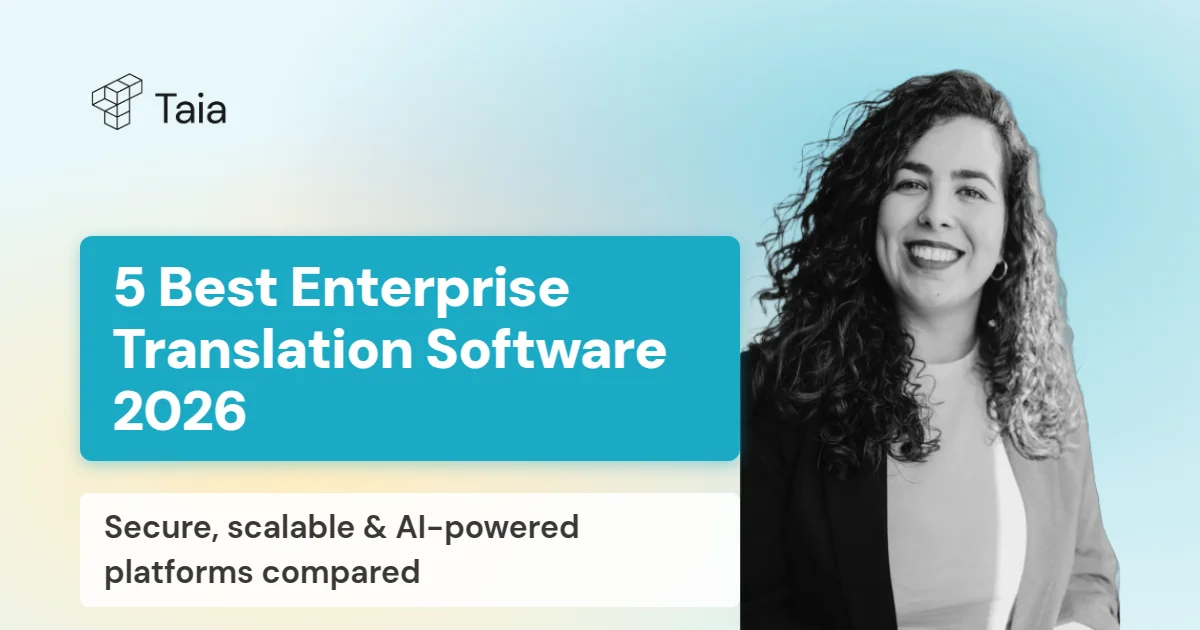
For teams that need to translate documents, marketing content, and product materials at scale — with ISO 17100 certification, shared translation memory, and hybrid AI + human workflows — Taia is the strongest enterprise translation platform in 2026. For developer-first teams managing software strings with deep CMS pipeline automation, Smartling or Lokalise are worth evaluating instead.
Quick Comparison: Best Enterprise Translation Software in 2026
| Platform | Languages | File Formats | TM / Glossary / Style Guide | ISO 17100 | Human Services | Starting Price |
|---|---|---|---|---|---|---|
| Taia | 204 | 65+ | ✓ / ✓ / ✓ | ✓ | Essential (€0.06/word), Enhanced (€0.09), Ultimate (€0.12) | Free; €9/month (Basic) |
| Smartling | 450+ | 30+ | ✓ / ✓ / ✓ | ✓ | Via ISO 17100-certified LSP network | Custom enterprise |
| Lokalise | 400+ | 30+ | ✓ / ✓ / ✓ (Advanced plan+) | ✗ | Via LSP marketplace | Subscription tiers |
| Phrase | 500+ | 50+ | ✓ / ✓ / ✓ | ✗ | Via partner LSP network | Custom |
| Smartcat | 280+ | 100+ | ✓ / ✓ / ✗ | ✗ | Freelancer marketplace | Freemium |
What Makes Enterprise Translation Software Truly Enterprise-Ready?
The right enterprise translation software centralizes every language, file, and workflow into one system — and the platforms that do this well share a consistent set of capabilities.
Centralized Project Management
Every language, every file, every workflow — visible in one dashboard. No more scattered spreadsheets or Slack chases to find out what has shipped.
Team and Role Control
Assign access by role or department so translators, reviewers, and vendors only see what they need. It keeps workflows clean and data secure across large organizations.
Translation Memory, Glossary, and Style Guide
Enterprises can’t afford inconsistency. A shared translation memory, approved terminology glossary, and style guide ensure that one brand voice stays intact across all markets and all three work together — each new approved translation makes future translations faster and cheaper.
Hybrid AI + Human Workflows
AI-powered translation handles volume and repetitive content, while linguists review and refine the output. The best platforms let you blend both without friction — either in-house or through professional services.
Data Security and Compliance
Encryption, GDPR alignment, and data residency options aren’t optional at the enterprise level — they’re expected. Confirm that content is never used to train AI models and that infrastructure is hosted in a defined region.
APIs and Integrations
A true enterprise translation management system plugs directly into your CMS, product pipeline, or content workflow — cutting out manual uploads entirely.
These capabilities turn translation from a series of one-off projects into a scalable, repeatable process that supports continuous updates, real-time collaboration, and measurable global impact.
The 5 Best Enterprise Translation Software in 2026
The platforms below stand out for their ability to handle enterprise-level translation workflows: collaboration, automation, security, and scalability — all in one ecosystem.
1. Taia — Best for Hybrid AI + Human Translation at Scale
Taia is an AI-first localization platform that combines instant AI translation in 204 languages and 65+ file formats, a built-in CAT editor and translation management system (TMS), and ISO 17100-certified professional linguists — with translation memory, glossary, and style guide shared across all three. If your organization needs both speed and precision, it’s the strongest enterprise choice for document-heavy workflows.
Key features:
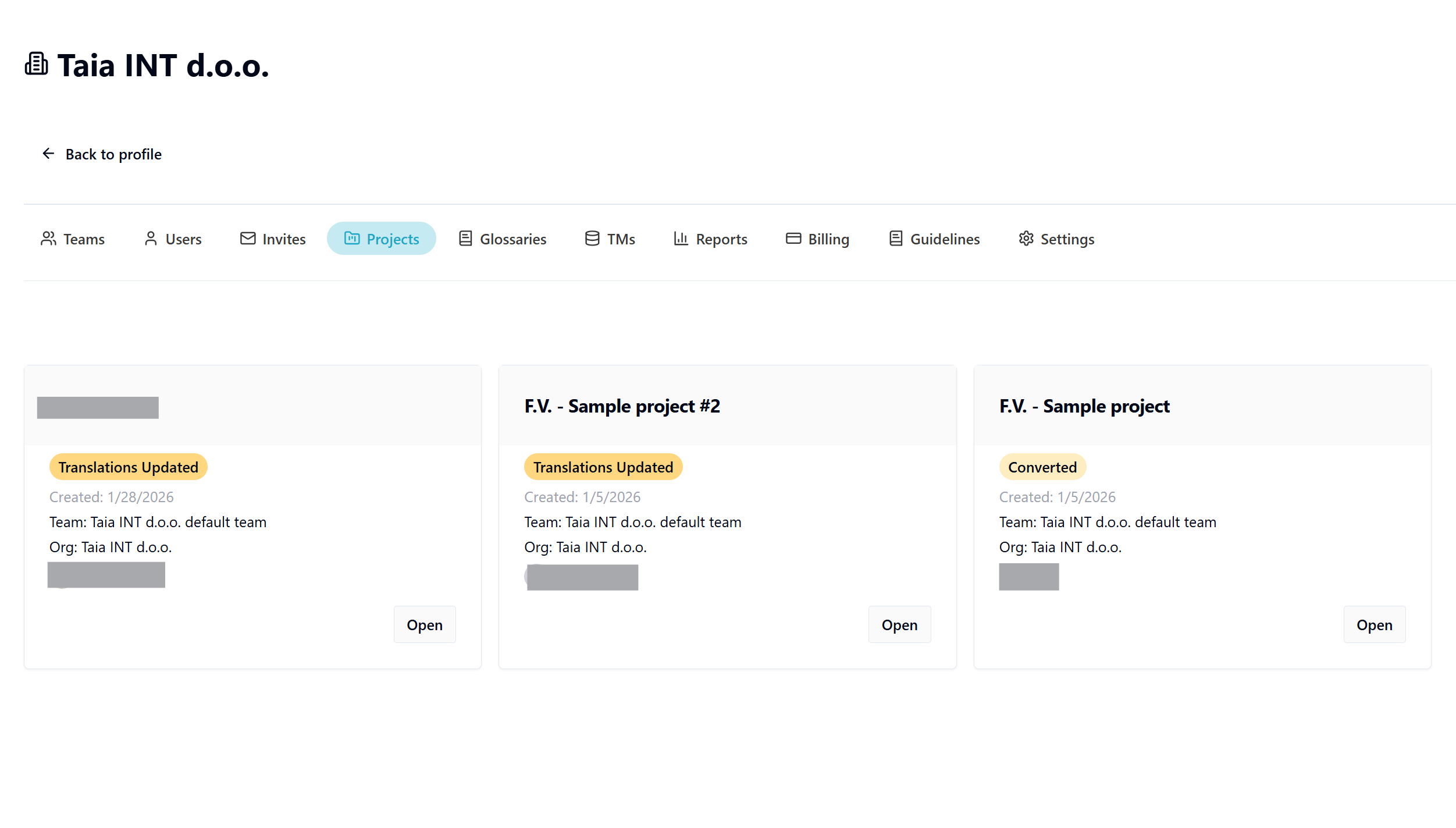
- Centralized project management dashboard with real-time status tracking across all languages and teams
- Three ways to translate: instant AI translation (subscription), Translation Studio for in-house teams to assign, review and edit (with a built-in CAT editor), and three professional service tiers — Essential (1 linguist, from €0.06/word), Enhanced (translator + reviser, ISO 17100, from €0.09/word), Ultimate (TEP, from €0.12/word)
- Translation memory, glossary, and style guide shared across AI translation and all professional tiers — style guide rules are automatically applied by Taia’s AI engine at translation time (not just shown to linguists), and the same guide is used by human reviewers in Essential, Enhanced, and Ultimate service tiers
- AI translator learns from your approved translations over time, improving accuracy on your specific domain
- 65+ file types, 204 languages, role-based team access, shared billing, and API access on Pro plans
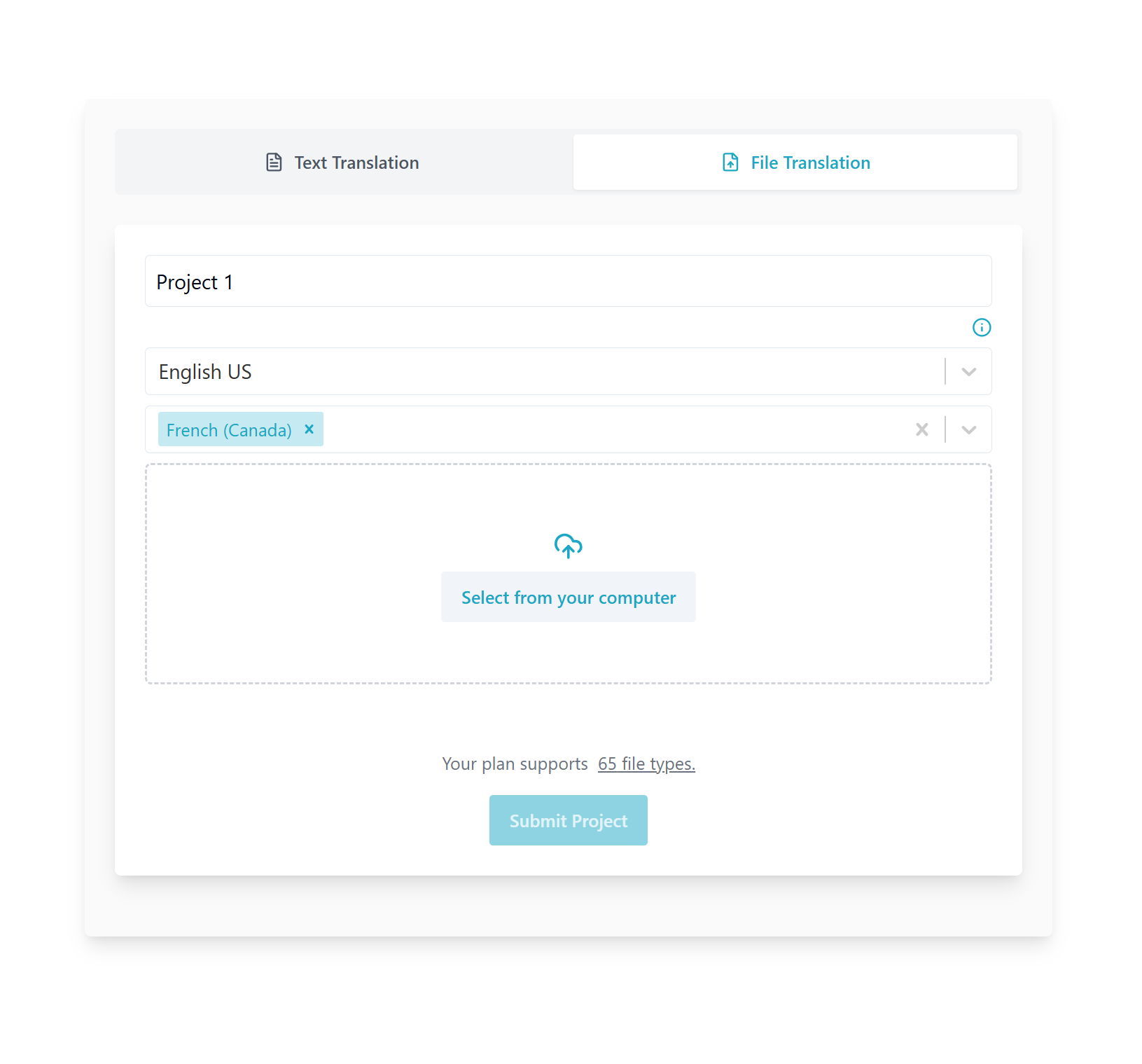
- No subscription required to order professional translation services — upload a file, get an instant quote, submit the project. Pay per word, nothing else.
- No integrations or developer setup needed to get started — the platform works out of the box for any team that can upload a file
- Data processed on AWS eu-west-1, GDPR-compliant, encrypted at rest and in transit — content is never used to train AI models
- Dedicated project manager included when ordering professional localization services
Trade-offs:
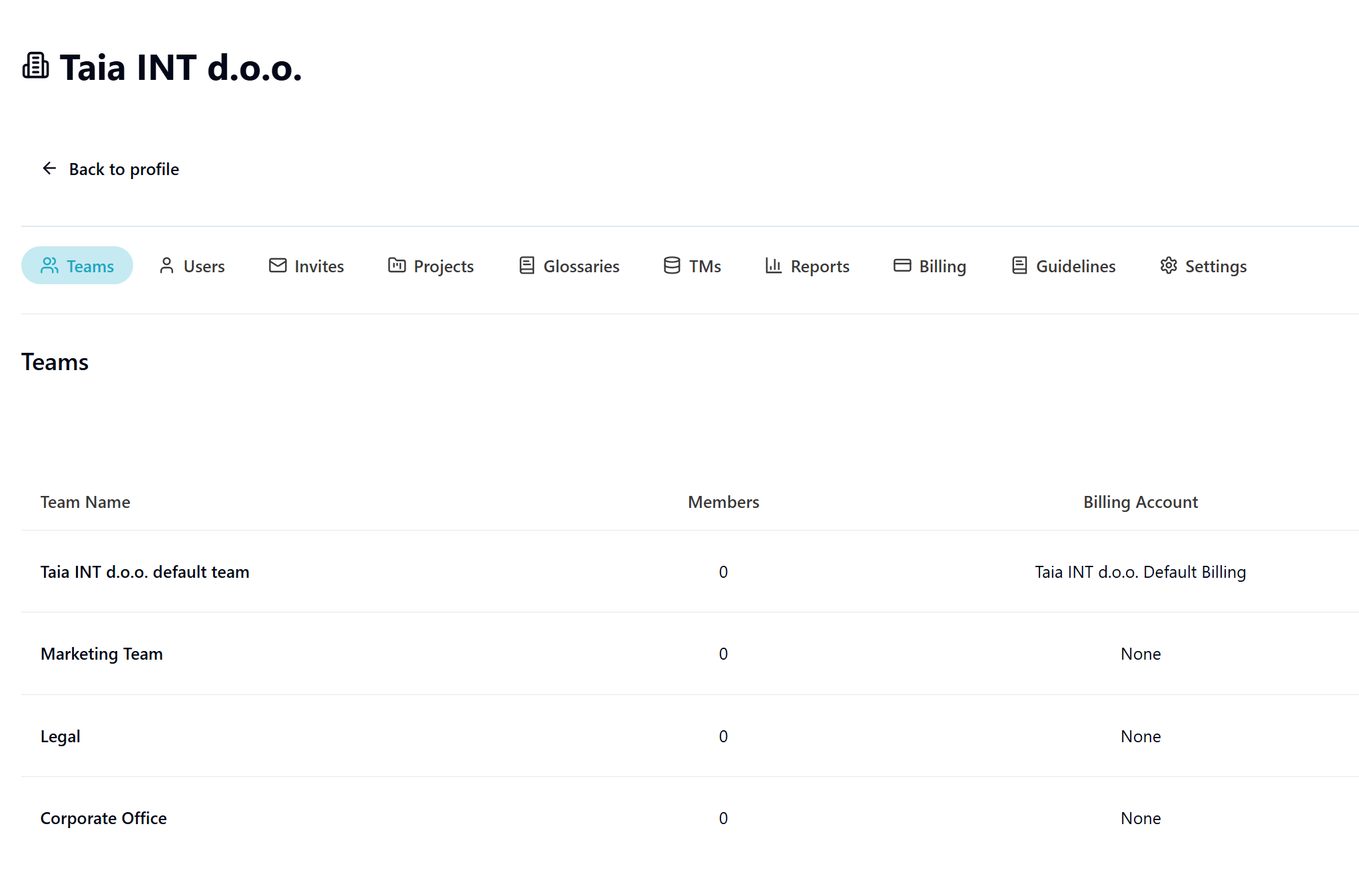
- Enterprise features (API and team management) available on Pro and custom enterprise plans only
- No desktop CAT client — fully cloud-based; teams used to installed software need adjustment time
Best for: Marketing teams, content teams, and any organization that needs to translate documents without a dedicated localization department or developer setup time. Also the right fit for teams that don’t translate daily — no subscription is required to access professional human translation, so occasional users aren’t paying for capacity they don’t use. And for teams that do translate at volume, the Pro plan adds API access, unlimited users, and full linguistic resource management.
Who it’s not for: Teams looking for a desktop-only CAT tool, or those whose primary content is software UI strings with developer-first Git pipeline automation.
Free plan available: Yes — start with Taia’s free AI translator and upgrade as you grow. Professional human translation services are available on any plan, including free, with no subscription required — upload a file, get an instant quote, pay per word.
Ready to Scale Your Enterprise Translation?
Taia combines AI speed with human expertise — all in one secure platform built for global teams.
Try Taia Free2. Smartling — Best for Enterprise Automation and Integrations
Smartling is the strongest choice when deep CMS and marketing stack integrations are the top priority. It connects directly to your content systems to eliminate manual file uploads across large enterprise environments.
Key features:
- Strong API and integration ecosystem for CMS, marketing platforms, and design tools
- Workflow automation and project tracking across large teams
- Built-in quality checks and linguistic asset management
- Enterprise-grade security options
Trade-offs:
- Significantly higher pricing than most alternatives — designed for large enterprise budgets
- Custom integrations often require developer involvement or paid support packages
- Steeper learning curve for non-technical users
Best for: Large enterprises managing frequent multilingual updates across departments, where dedicated engineering resources can configure and maintain the integrations.
Who it’s not for: Smaller teams, companies without localization budgets, or teams that need fast self-serve document translation without a long implementation phase.
3. Lokalise — Best for SaaS and Product Localization
Lokalise is the right choice for software and app teams that need continuous localization of UI strings via Git-based pipelines. It’s built for developer workflows, not document-heavy localization.
Key features:
- API-first approach with GitHub, GitLab, and Bitbucket integrations
- Real-time in-context editing for UI and mobile apps
- Collaborative workspace for developers, translators, and reviewers
Trade-offs:
- Pricing scales quickly as projects and users grow
- Interface leans heavily developer-first, which can frustrate linguists and non-technical reviewers
- Less suited for document-heavy workflows outside of software strings
Best for: SaaS and tech teams shipping regular product updates in multiple languages with developer-driven deployment pipelines.
Who it’s not for: Enterprises translating documents, legal content, or marketing materials — or those without significant developer involvement in the localization process.
4. Phrase — Best for Marketing and Multi-Channel Content
Phrase (formerly Phrase TMS) covers localization for marketing, design, and product teams, supporting everything from website copy to app strings with strong workflow flexibility.
Key features:
- Translation memory and terminology management
- Built-in automation and customizable approval workflows
- Native connectors for Figma, WordPress, and GitHub
- Analytics and reporting on higher-tier plans
Trade-offs:
- Style guide is auto-applied by Phrase’s own Language AI engine, but ignored by third-party MT engines configured through the platform
- Significant setup time — customization options can feel overwhelming without a dedicated localization manager
- Key analytics and reporting features are locked behind higher-tier plans
- Pricing structure is complex to evaluate before committing
Best for: Marketing and localization teams managing cross-channel content with creative demands and varied content types.
Who it’s not for: Teams with purely technical products and no need for creative content localization — Phrase’s strength is in marketing and design workflows, not document translation at scale.
5. Smartcat — Best for Distributed Teams with External Vendor Networks
Smartcat combines an AI translation engine with a large network of freelance linguists, making it practical for companies that rely heavily on external vendors and need built-in payments.
Key features:
- Collaborative workspace for in-house and external translators
- AI translation engine with post-editing tools
- Automated payments and vendor management
- Integrations with popular CMS and TMS tools
Trade-offs:
- Freelance marketplace model may raise data-security questions for sensitive or regulated content
- Limited project-reporting granularity compared to purpose-built enterprise TMS platforms
- Some enterprise users report UI performance issues on large projects
Best for: Enterprises managing multilingual projects across multiple regions with a mix of in-house staff and external translators who need a single payment workflow.
Who it’s not for: Highly regulated industries where external vendor access to source content must be strictly limited by contract or compliance requirements.
When Another Platform Is the Better Choice
Honest evaluation means naming when a competitor beats Taia for a specific situation.
Choose Smartling if: Your priority is automated content synchronization with enterprise CMS platforms (Adobe Experience Manager, Contentful, Salesforce), you have a dedicated dev team to configure and maintain the integration, and budget is not a constraint.
Choose Lokalise if: Your primary content is software UI strings, your workflow is Git-based, and your localization team works inside a developer-first environment. Lokalise’s in-context editor for live app translation is better than Taia’s for this use case.
Choose Phrase if: You manage high-volume marketing content across Figma, WordPress, and GitHub simultaneously, and you need a flexible multi-step review workflow built specifically for creative and marketing teams.
Choose Smartcat if: You rely on a large, distributed network of freelance translators and need built-in vendor management and payment automation. The freelancer marketplace model suits high-volume, externally sourced translation that doesn’t involve regulated or confidential content.
Taia is the stronger choice when you need ISO 17100-certified human translation alongside AI, need document formats like DOCX, PDF, IDML, XLIFF, and SRT to render correctly after translation, and want translation memory, glossary, and style guide to work across both AI and human workflows without maintaining separate systems. It’s also the right call for teams that don’t translate daily or don’t have a localization engineer — no subscription is required to submit professional translation projects, no integrations need to be built, and the platform is ready to use from day one for anyone who can upload a file.
How to Choose the Right Enterprise Translation Software
Choosing an enterprise translation platform means matching it to how your organization actually works — not the longest feature list.
Map Your Content Ecosystem First
Before comparing platforms, audit what you’re translating most often. Product UI strings, legal documents, DOCX marketing materials, and IDML InDesign files each demand a different balance between automation, format preservation, and human review quality. A platform optimized for software strings often handles IDML poorly, and vice versa.
Define Your Workflow Before Demos
Do your translators work in-house, through agencies, or both? Do reviewers need access before publication? Map the real process first — the right TMS mirrors your workflow, not the other way around.
Confirm Security Specifics
If your content includes confidential information — and most enterprise content does — verify encryption in transit and at rest, role-based access controls, regional data hosting specifics, and whether customer content is used to train AI models (with Taia, it never is).
Test Integrations Against Your Stack
The best enterprise translation software fits into your existing CMS, CRM, or code repositories without requiring months of custom development. Request a technical proof of concept before committing.
Compare Pricing Models Carefully
Enterprise pricing varies across per-word (human services), per-subscription (AI translation tiers), and per-seat (some TMS tools). Look for transparent, usage-based pricing that scales with your needs. Taia’s Free, Basic (€9/month, 20,000 credits) and Pro (€39/month, 100,000 credits) tiers make it straightforward to start small and scale without renegotiating a contract. One credit is one word with Standard AI.
Conclusion
When translation becomes part of your core operations, it stops being a service and becomes infrastructure. The right enterprise localization platform automates what slows you down, protects what matters most, and keeps your teams working across languages without tool-switching or vendor management overhead.
Taia is built for teams that need document translation at scale with ISO 17100-certified quality, shared translation memory and glossary across both AI and human workflows, and transparent pricing that doesn’t require a procurement cycle to start.
Start with instant AI translation on the free plan, add professional human review when quality demands it, or run both in parallel across markets.
Start Translating Smarter Today
Try Taia now — free to start, built for teams of any size, and ready for enterprise scale when you are.
Get Started Free
Project Manager & Content Writer
Eva is a project manager and occasional content writer who has honed her skills in marketing localization since 2019. Like most millennials, she's a Potterhead. She loves traveling and collecting bookmarks, used books, and vinyl.