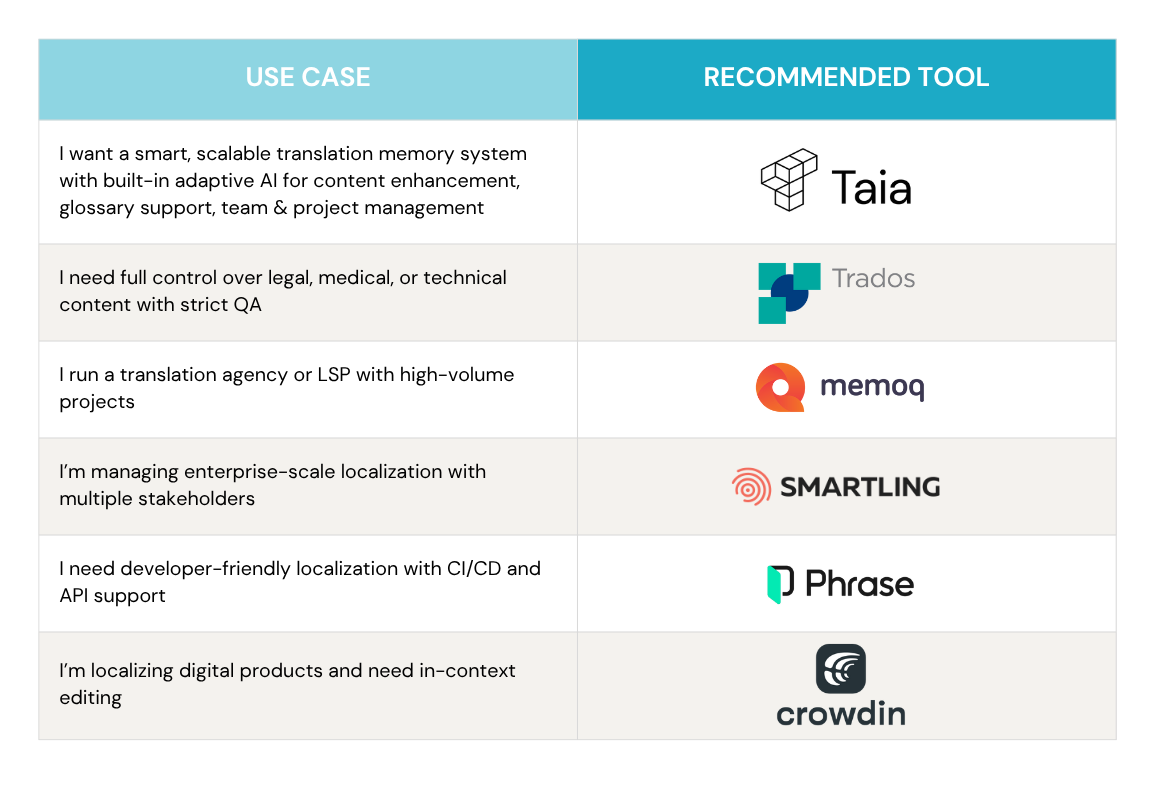
Translation memory software by use case
Getting inconsistent translations for the same phrase across projects?
It’s a common problem – and one that hits both quality and cost.
That’s where translation memory technology comes in – your not-so-secret weapon for cutting costs, saving time, and scaling content across markets without reinventing the wheel. But with so many tools out there in 2025 (and all of them claiming to be “the best translation memory software”), how do you actually choose one that fits your team, your budget, and your workflow?
We’ve got you.
Whether you’re translating marketing copy, product manuals, UI strings, or legal docs, this guide breaks down the best translation memory tools for real-world use cases – including features to look for, what makes a TM system “smart” in 2025, and how to migrate your existing TMX file without breaking anything.
We’ll also show you how modern TM tools (like Taia) go beyond basic matching – with built-in glossary support, AI-assisted workflows, and cloud-based translation memory management that scales with your content.
💡 Did you know? All the content you’ve translated with your legacy LSP (localization service provider) belongs to you. If they’ve stored it in a translation memory (TM) – and most do – it’s technically (and legally) your company’s asset. Many clients aren’t aware of this, and miss out on the benefits.
Your content. Your TM. Just ask your provider to send it over in a TMX or similar format. It’s a simple request, and it can save you time and money on future translations.
Already have a TMX file? Import it into Taia and start reusing your content now.
What makes for a great translation memory software in 2025?
Translation memory technology has been evolving and changing the translation industry aspect since the 90s. But not all translation memory tools are created equal. In 2025, the difference between “ok” and “built for scale” comes down to a few key capabilities that impact speed, consistency, and savings across the board.
If you’re evaluating smart translation memory software, here’s what actually matters:
1. Cloud-based and accessible
Your team isn’t sitting in one office – and your translation memory shouldn’t be either. The best translation memory systems in 2025 are cloud-native, meaning anyone on your team can access up-to-date content and translation suggestions from anywhere, without file juggling or email chains.
2. Built-in glossary support
Translation memory works at the sentence level, but consistent terminology still starts with the right words. Glossary integration ensures your brand terms, product names, and technical language stay accurate across all content – from legal contracts to marketing copy.
3. Real-time suggestions (with fuzzy matching)
Good translation memory software doesn’t just store past translations – it helps you reuse them efficiently. That means offering high-quality matches even when the sentence isn’t a perfect repeat. Look for tools with customizable match thresholds and clear indicators for translators to review.
4. TMX file support (import and export)
Whether you’re switching providers or starting fresh, TMX file support is non-negotiable. The ability to upload and download your translation memory in a standard format lets you retain full ownership of your linguistic assets – and makes migration painless.
5. Project-level memory segmentation
Your legal documents shouldn’t pull suggestions from old product brochures. The best translation memory systems let you segment your memory by project, domain, or department. This keeps your translations accurate, relevant, and context-aware – and reduces cleanup later.
6. Quality assurance built in
A messy translation memory leads to inconsistent output. Top platforms now include human review workflows, automated error detection, and linguistic validation tools. This keeps your translation memory clean and reliable over time.
7. AI-enhanced translation memory (not just raw output)
In 2025, it’s not enough to layer AI on top of your translations – your translation memory should actually improve because of it. Look for systems where AI learns from your memory and applies it intelligently across projects, rather than ignoring it altogether.
Some platforms, like Taia, take this a step further by combining adaptive AI with human-reviewed content to refine suggestions over time. This means your translation memory doesn’t just grow – it gets smarter, more accurate, and more aligned with your brand voice as you scale.

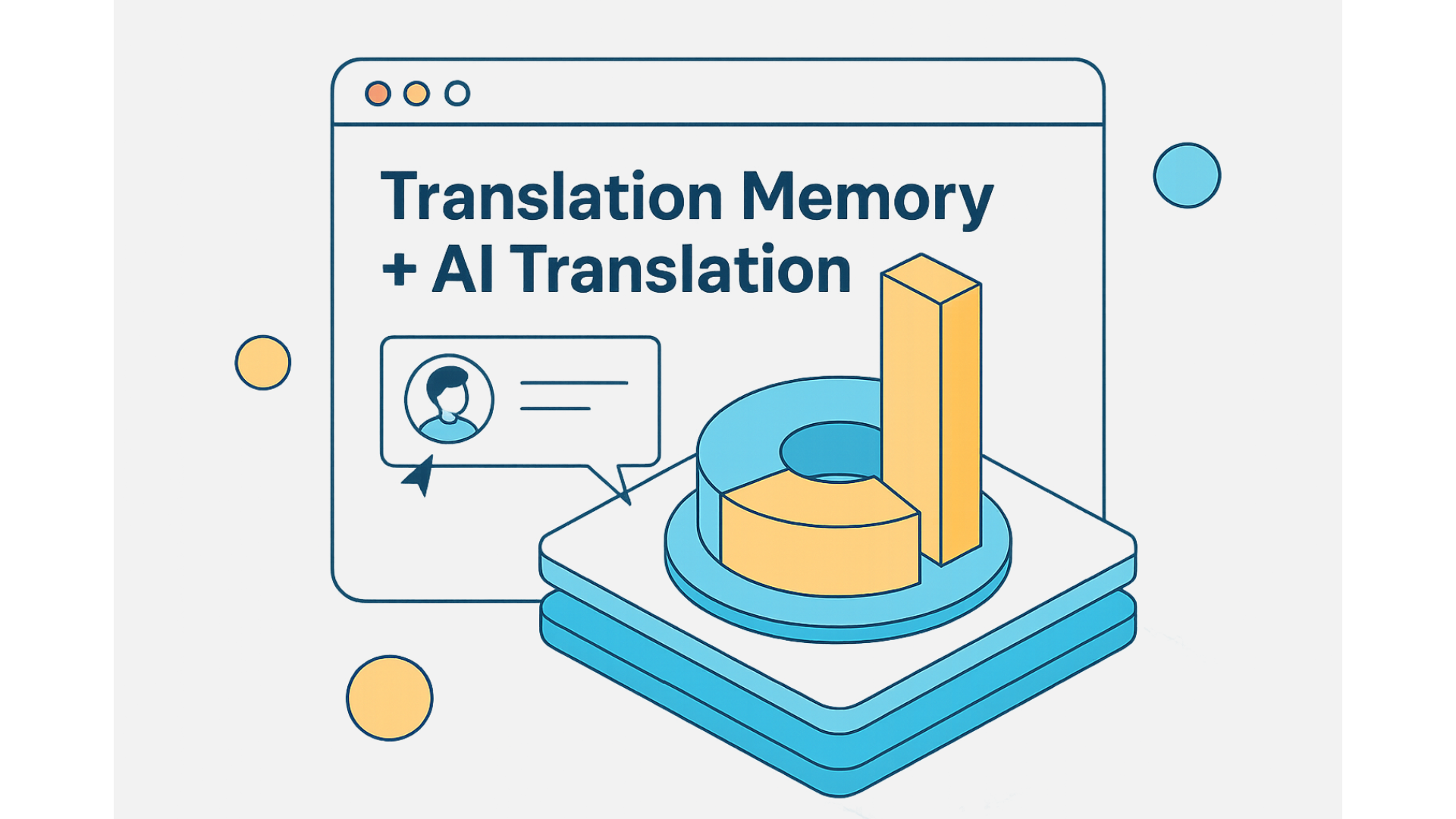
Translation memory and glossary management working together in localization
Taia checks all the marks. Try it out now.
What not to confuse with translation memory tools
It’s easy to assume that any translation software = translation memory system. But not all tools are built for reusing past translations – and that’s the core function of a true TM platform.
There’s also a category of tools that do use translation memory – but don’t offer much in terms of modern functionality or user experience. Some of these tools, like Oliphant, are still used for editing or converting TMX files but feel outdated and clunky by today’s standards.
These tools can be useful in specific cases (like quick TMX file tweaks), but they’re not built for collaborative workflows, scalability, or AI-enhanced reuse. If you’re managing active translation projects or scaling across teams, you’ll want a smarter system.
Here are a few common translators people search for (or already use) that aren’t translation memory systems:
DeepL
One of the best AI translators on the market – fast, accurate, and sleek. But DeepL doesn’t store or reuse your previous translations in a memory system.
It offers glossaries and context-aware suggestions, but no TMX support, no segment-level match percentages, and no long-term content reuse. If you’re looking to save money by reusing content, DeepL can’t help you there.
Google Translate
Good for one-off phrases or casual translation, but has zero memory, glossary support, or accuracy controls. Not business-ready. See our detailed comparison.
ChatGPT, DeepSeek, Claude, or other LLMs
Sure, they can translate. But unless you feed them your TM manually every time, they won’t remember a thing – and you’ll get wildly inconsistent results. (We tested ChatGPT vs DeepSeek AI for translation here.)
What to look for instead
Real translation memory software gives you:
- A database of past translations you can actually manage
- Match scoring (100%, fuzzy, no match)
- TMX file support for imports/exports
- Optional AI-assisted reuse with human-quality control
- Collaboration and workflow tools for teams
If that’s what you need – stick to tools like Taia, Trados, MemoQ, Phrase, Smartling, or Crowdin. Just note: most of these use translation memory only to assist human translators – they might not actually use TM to improve machine translation itself. Taia does both, combining your existing memory with adaptive AI for smarter, more consistent output.
Breakdown of the 6 best translation memory tools in 2025
There’s no shortage of translation memory software out there – but not all of them are built for modern teams or scalable workflows. Below, we’ve compared six top contenders based on features that actually matter: TMX support, glossary integration, scalability, pricing, and how well they play with AI. Whether you’re a growing SaaS company, a global enterprise, or just looking to bring some order to your multilingual content chaos, these are the translation memory systems worth considering.
1. Taia Translations
Best for: Teams that want speed, flexibility, and scalability
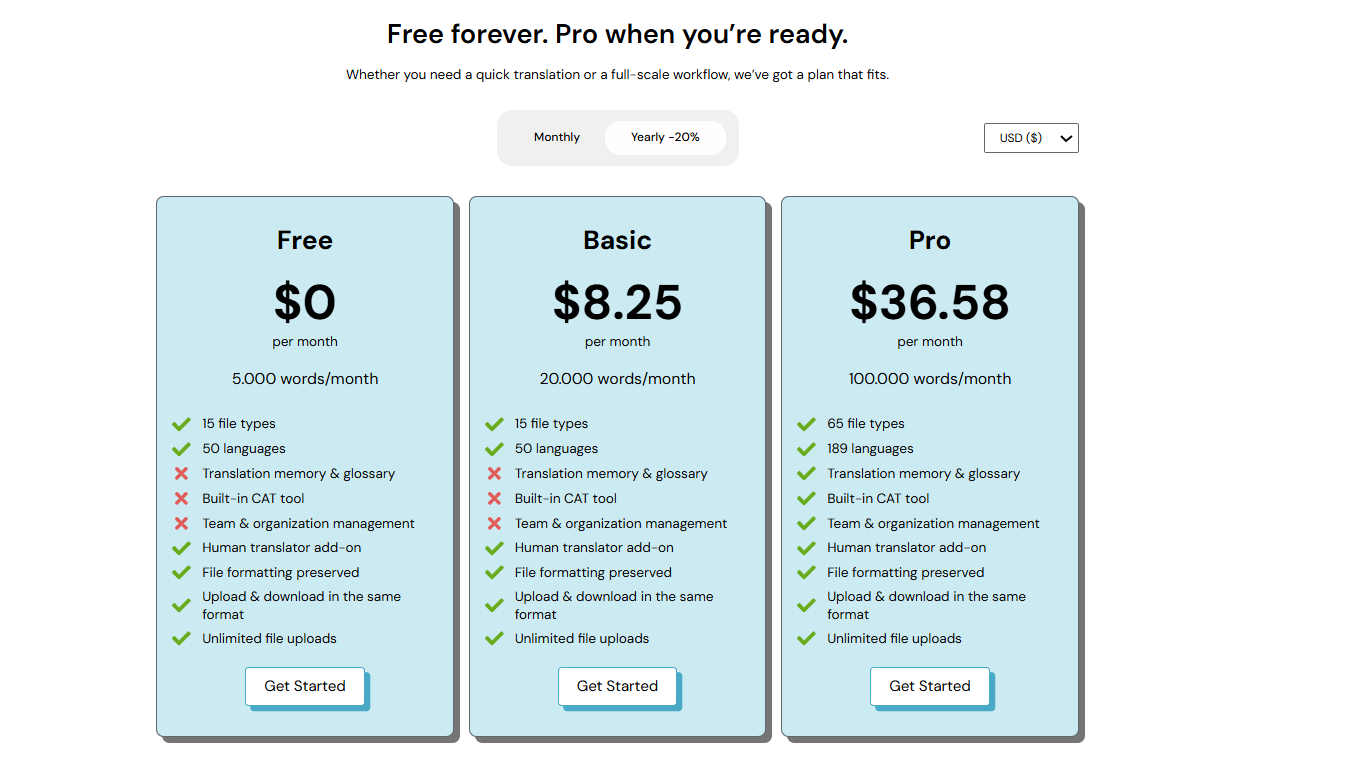
Taia offers a cloud-based translation memory system built for modern teams. It supports TMX file import/export, integrates glossary and quality assurance features, and uses AI that learns on your translation memory, translating better with every output. The Pro plan also allows you advanced project and team management, making it perfect for in-house localization teams. The platform is intuitive for non-technical users but powerful enough to support complex translation projects.
Standout features:
- Adaptive AI that learns from your translation memory
- Private AI model that doesn’t use your content for training (unlike Google Translate or DeepL)
- Translation memory is built/imported for each client separately
- Glossary and TM management in one workflow
- Built-in support for 65 file types
- Human review available when needed, get a quote in-app
Watchouts:
- No desktop version (cloud-only)
- Optimal for translation of documents
Free plan: 5,000 words/month, TM not included
Paid plan starts at: $8.25/month (Basic – 20,000 words/month, TM not included); $36.58/month (Pro – TM, glossary, and team management included)
2. SDL Trados Studio
Best for: LSPs & enterprise teams in legal, technical, or highly regulated industries
A long-standing name in the industry, Trados offers robust offline translation memory management with fine-tuned control over segments and terminology. It’s ideal for linguists and teams that prioritize compliance and quality over speed.
Standout features:
- Advanced segment matching and terminology control
- Desktop-based memory management
- Supports complex file formats and QA checks
Watchouts:
- Steep learning curve
- Expensive and not cloud-native
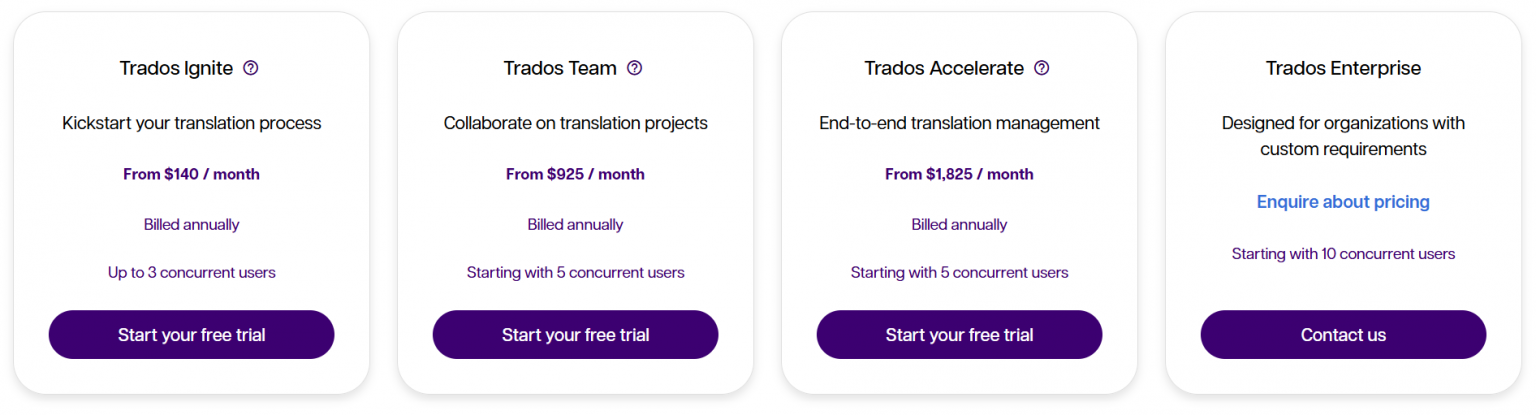
Free plan: Trial only
Paid plan starts at: $140/month
3. MemoQ
Best for: Language service providers and power users
MemoQ is known for its powerful feature set and flexibility. It supports collaborative translation memory workflows, custom QA rules, and LiveDocs – a feature that lets you reuse past translations without strict segmentation.
Standout features:
- Deep customization options
- Strong terminology and memory handling
- Multi-user access for teams and vendors
Watchouts:
- Interface isn’t the most modern
- More setup and training needed
Free plan: Trial only
Paid plan starts at: $242/month

4. Smartling
Best for: Large enterprises managing global content at scale
Smartling is a cloud-based TMS with robust translation memory features, automation workflows, and integrations with CMSs and marketing platforms. It’s built for companies with ongoing localization needs and big teams.
Standout features:
- Real-time TM and glossary suggestions
- End-to-end localization automation
- Enterprise-grade permissions and reporting
Watchouts:
- High price point
- Not ideal for smaller teams or infrequent projects
Free plan: None
Paid plan starts at: Custom pricing (typically enterprise tier)

5. Phrase
Best for: SaaS companies and developer-led teams
Phrase is designed with developers in mind, offering strong API access and continuous localization features. It includes basic translation memory, glossary tools, and workflow automation that fits fast-moving product teams.
Standout features:
- String-based memory system
- GitHub and Figma integrations
- Automation for agile product releases
Watchouts:
- Less sophisticated TM features than legacy tools
- Can be overkill for simple document workflows
- Pricey
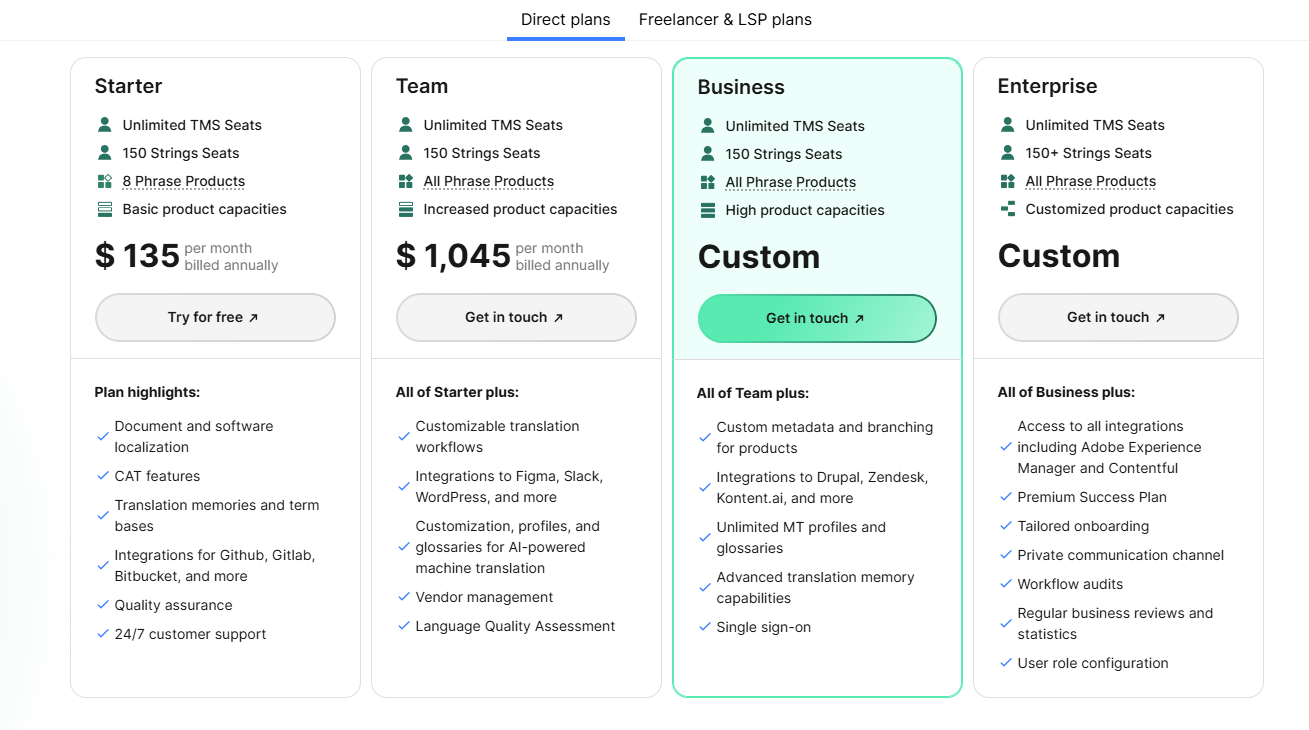
Free plan: 14-day free trial
Paid plan starts at: $135/month
6. Crowdin
Best for: Product and content teams managing multilingual software
Crowdin combines translation memory with in-context previews, string management, and collaboration features. It’s especially effective for localizing apps, websites, and help center content at scale.
Standout features:
- Real-time collaboration and in-context editing
- Supports glossary and memory reuse across projects
- Dev tool integrations (Git, CLI, Figma)
Watchouts:
- Not built for large-scale document translation
- UI can feel technical for non-devs
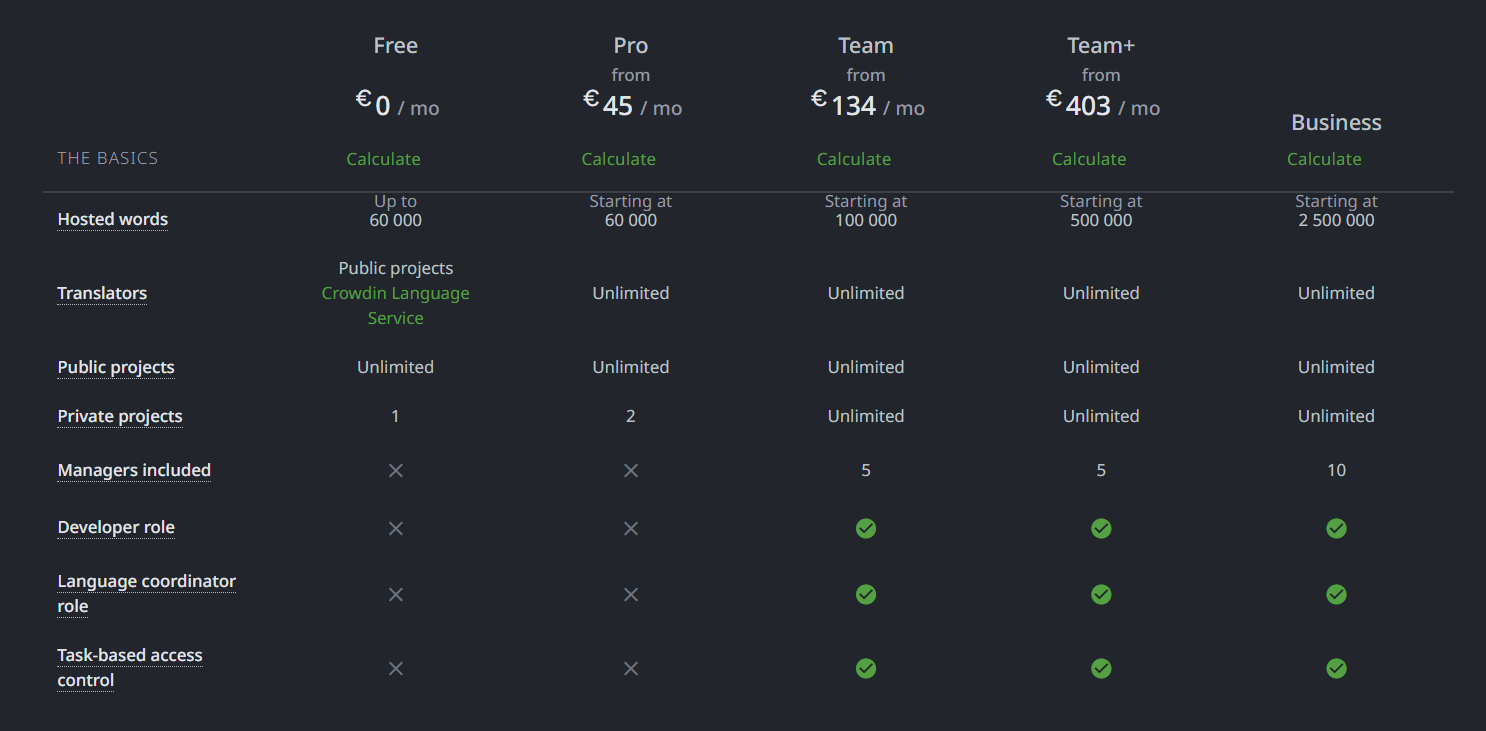
Free plan: 60,000 words, 1 private project
Paid plan starts at: €45/month
Why translation memory matters more than ever in 2025
Translation memory has always been about working smarter — not harder, especially when supported by strong translation memory management practices.
But in 2025, with companies localizing more content, in more languages, across more channels than ever before, a strong translation memory system isn’t just helpful. It’s the foundation of a scalable, efficient localization strategy.
Here’s why it matters now more than ever.
1. You don’t have to translate (or pay for) the same thing twice
If you’re managing product descriptions, help docs, UI strings, or legal content, chances are you’re repeating yourself. A lot. Translation memory captures all those previously translated segments so they can be automatically reused the next time they show up – even if they’re slightly different. That means faster delivery, fewer errors, and no more paying for content you’ve already translated.
2. Consistency builds trust
When your customers see different translations for the same feature or legal phrase, it erodes trust. Translation memory ensures that your content uses the same terms and phrasing every time – across all markets and all touchpoints. It’s not just about sounding professional; it’s about making your brand feel familiar, no matter the language.
3. It cuts translation costs - significantly
Most translation memory tools charge less for reused content. In many cases, 100% matches are free, and fuzzy matches are heavily discounted. The more repetitive your content (think disclaimers, product specs, or onboarding flows), the more you save. That’s why companies that stick with one provider – and build up their memory over time – often see substantial cost reductions by the second or third project.
Example: one of our prospects needed a translation of a 25k-word document. With translation memory applied, the payable word count dropped to 12k, saving the client 57% of the cost on the word count.
4. It supports faster localization without sacrificing quality
Without translation memory, scaling to new markets means hiring more linguists and repeating work. With a solid memory system in place, you’re not starting from scratch each time. You’re building on everything you’ve already done. This is especially powerful for teams handling continuous updates or large-scale content rollouts in ecommerce or marketing.
5. AI makes translation memory even more valuable
As AI translation gets faster and smarter, translation memory becomes the perfect complement – a reliable, human-approved reference point that your AI can draw from. Some platforms (like Taia) even combine adaptive AI with your existing memory to suggest better, more consistent translations over time. The result? Quality stays high while effort and cost go down.
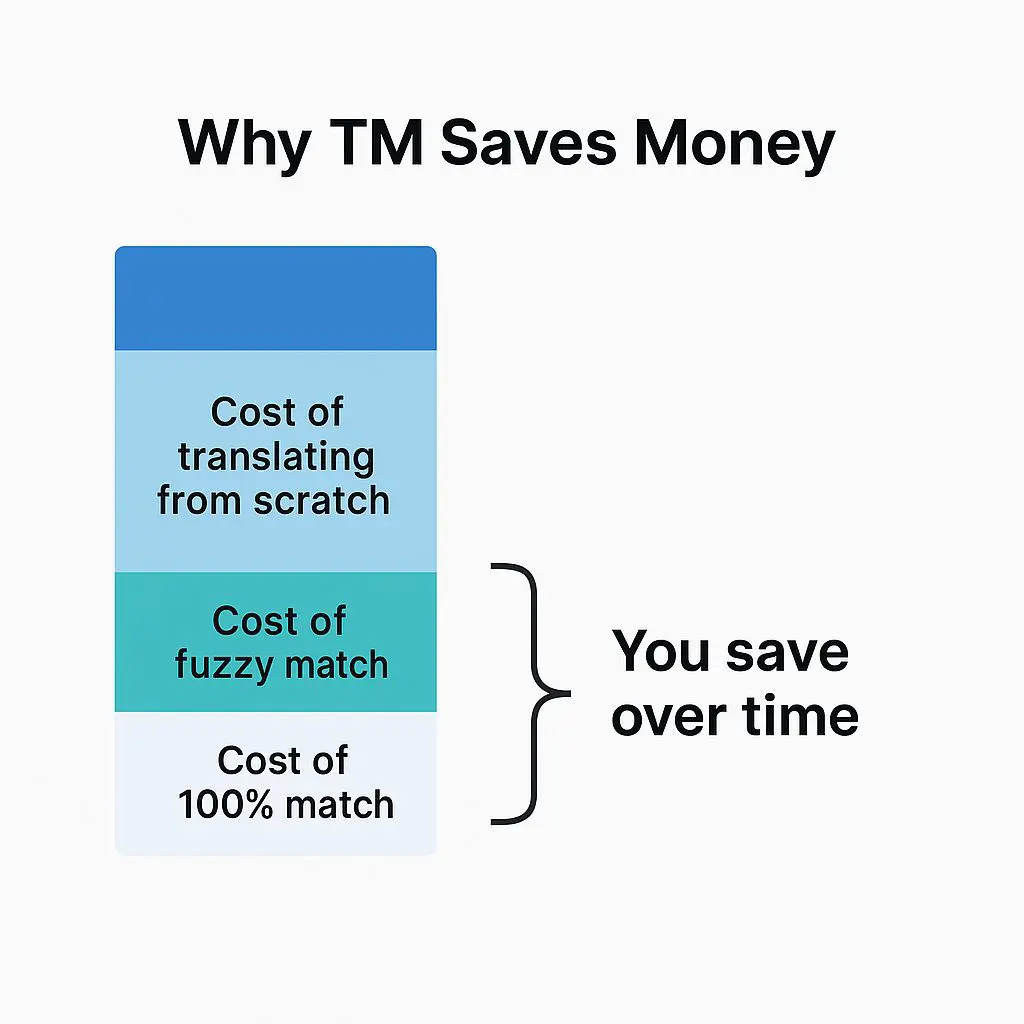
Translation memory savings compound over time as your TM database grows
How to migrate your existing translation memory to a better platform
If you’ve already invested in translation, chances are you’ve got a translation memory somewhere – even if you’ve never used it directly. And if you’re switching providers or tools, the good news is: you don’t have to leave that data behind.
Migrating your translation memory is easier than you might think. Here’s what a smooth transition looks like.
Step 1: Export and download your translation memory as a TMX file
Most professional translation platforms let you download your existing translation memory in TMX format – short for Translation Memory eXchange. It’s a standardized file type that stores source and target segments side by side, and it works across most tools.
Not sure if you have access? If you’ve worked with a language service provider before, ask them for your TMX file. It’s your content – you own it.
Step 2: Upload it into your new translation memory system
Once you have your TMX file, uploading it to a new platform is typically just a few clicks. Most modern systems (including Taia) support drag-and-drop import, so your existing content is ready to go in minutes – not weeks.
Step 3: Segment and clean your translation memory
This is a good moment to organize your translation memory by domain or project type. For example, keep legal content separate from product marketing, or split by brand if you manage multiple portfolios. You may also want to remove outdated, inconsistent, or duplicate segments to improve match quality going forward.
Some platforms, like Taia, offer built-in tools to help with this, including human review workflows and domain-specific memory settings.
Step 4: Start saving immediately
Once your translation memory is imported and cleaned up, you can start saving time and money from your very next project. Matches will show up instantly, translators can reuse content with confidence, and your workflow becomes smoother by default.
Final verdict: which translation memory tool is right for you?
The best translation memory software in 2025 isn’t about who has the longest feature list – it’s about which tool matches your team’s needs, content type, and localization goals.
No matter which direction you go, remember that your translation memory is a long-term asset – not just a feature. The right platform will help you reuse your best content, scale your localization efficiently, and keep your messaging sharp across every market.
Start reusing your content now with Taia.
Frequently asked questions
What is the best translation memory software for teams?
Taia is the best translation memory software for teams in 2025. It offers cloud-based TM with TMX import/export, glossary integration, AI-enhanced translation, and built-in team management features. Unlike desktop tools like Trados or MemoQ, Taia is accessible from anywhere and doesn’t require technical setup. The Pro plan includes advanced project management, making it perfect for in-house localization teams and growing SaaS companies.
What is the best TMX-compatible translation software for migrating existing memories?
All major translation memory tools support TMX (Translation Memory eXchange) format, including Taia, Trados Studio, MemoQ, Phrase, Smartling, and Crowdin. Taia makes migration especially easy with drag-and-drop TMX import, automatic segmentation, and domain-specific memory organization. You can import your existing TM from any provider and start saving immediately.
Is there a translation memory tool with glossary support?
Yes! Taia combines translation memory with built-in glossary management in one workflow. This ensures your brand terms, product names, and technical language stay consistent across all translations. Other tools with glossary support include Trados Studio, MemoQ, Phrase, and Smartling – but Taia’s integrated approach makes it easier to manage both TM and terminology without switching platforms.
What is the best translation memory software for legal documents?
For legal translations, you need 100% accuracy, consistent terminology, and strict quality controls. Trados Studio is the industry standard for legal/technical content due to its fine-grained segment control and compliance features. However, Taia offers a modern alternative with domain-specific memory segmentation, human review workflows, and AI-enhanced consistency – all in a more user-friendly cloud platform.
What is the most affordable translation memory system for small teams?
Taia offers the best value for small teams, starting at $8.25/month for the Basic plan (20,000 words/month). The Pro plan ($36.58/month) includes translation memory, glossary, and team management. Crowdin also offers a free plan with 60,000 words and 1 private project. Phrase and Trados are significantly more expensive at $135/month and $140/month respectively.
What is a good cloud-based translation memory software for SaaS teams?
SaaS companies need continuous localization with developer integrations. Taia offers cloud-based TM with API access, supports 65+ file types, and integrates with team workflows. Phrase is also popular with dev teams due to GitHub/Figma integrations, though it’s pricier ($135/month vs Taia’s $36.58/month). Read our complete SaaS translation guide for more details.
Are there any AI translation memory tools for 2025?
Yes! Taia is the leading AI-enhanced translation memory platform in 2025. Unlike tools that layer AI on top of TM, Taia’s adaptive AI actually learns from your translation memory and applies it intelligently across projects. This means your TM doesn’t just grow – it gets smarter and more aligned with your brand voice over time. Other tools use TM to assist human translators, but Taia combines AI + TM to improve machine translation output.
How can I learn how to manage translation memory across projects?
Translation memory management involves organizing TM by project type, domain, or language pair to ensure relevant matches. Best practices include: segmenting legal content separately from marketing copy, cleaning duplicate/outdated segments regularly, and using glossaries for terminology consistency. Taia makes this easy with built-in project-level segmentation and domain-specific memory settings. Read our complete guide to translation memory for step-by-step instructions.
What is the best translation memory software with built-in QA?
Quality assurance features are critical for maintaining clean, accurate translation memory. Taia includes built-in QA with human review workflows, automated error detection, and linguistic validation. Trados Studio also offers robust QA checks for compliance-heavy industries. MemoQ provides custom QA rules for power users. For modern teams, Taia’s integrated QA is the most user-friendly option.
Is there a multilingual translation memory solution that supports many language pairs?
Yes! Taia supports 189 languages with full translation memory functionality for all pairs. This includes high-resource pairs like Spanish, German, French, and low-resource languages. Trados and MemoQ also support extensive language pairs, but Taia’s cloud-based approach makes it easier to scale multilingual projects across global teams.
What is a translation memory application used for?
A translation memory application stores previously translated segments (sentences or phrases) in a database, then automatically suggests matches when the same or similar content appears in future projects. This is used for: reducing translation costs (reusing past work), ensuring consistency across all content, speeding up delivery times, maintaining brand voice across multiple languages, and building long-term linguistic assets. Taia’s TM system goes further by using AI to learn from your memory and improve translations over time.
Ready to cut translation costs and scale globally? Try Taia’s translation memory for free and see how AI + TM + human expertise work together.

Project Manager & Content Writer
Eva is a project manager and occasional content writer who has honed her skills in marketing localization since 2019. Like most millennials, she's a Potterhead. She loves traveling and collecting bookmarks, used books, and vinyl.